Showing posts with label Monroe vicariate. Show all posts

Saturday, August 25, 2018

St. Michael the Archangel (Monroe)


German immigrants began settling in Monroe circa 1840. In 1845,  Fr. Simon Saenderl, a Redemptorist priest, ministered to German-speaking Catholics in a second-floor chapel of the St. Mary rectory. He was soon sent to minister in Hillsdale and Lenawee Counties and was replaced by Fr. Peter Kronenberg.
An undated postcard of the current church -Source

T
he founding families bought property on Humphrey Street. However, when the home and land of Monroe’s first mayor, George B. Harleston, was up for sale, the congregation bought the property for $2,000. On that land stands, today, the parish church and rectory. 

The former home of the mayor was soon converted into a church. Fr. Bernard Hafkenscheid, Provincial of the Redemptorists in America, blessed the church on the Feast of St. Michael the Archangel, September 29, 1852. The patronage of St. Michael was chosen at the request of Michael Lauer, a local businessman and generous donor.

On May 3, 1860, Fr. Julian Maciejewski arrived at St. Michael as the first resident pastor. He died a year later and was buried at Mt. Elliot Cemetery in Detroit. Fr. Remigius VanDerHeyden, vicar at nearby St. Mary, was temporary rector for a few months until the arrival of Fr. Bernard C. Stentzel in November of 1861. Two years later, Fr. Benjamin Schmittdiel began a thirty-six year term as pastor.
An 1866 map of Monroe shows St. Michael Church on the bottom left side - Source

Fr. Schmittdiel oversaw the construction of a permanent church. The parish purchased of a set of plans and specifications that had been used in the recent construction of the Cathedral of the Immaculate Conception in Fort Wayne, Indiana. John Wahl began work on the church and the cornerstone was laid on June 12, 1866.

The total cost of construction, excluding tower and bells, was $30,000. On the Feast of the Guardian Angels, October 2, 1867, the church was consecrated by Bishop J. H. Luers of Fort Wayne. Bishop Lefevere was too sick to conduct the rites of consecration. 


The church spire was completed on Thursday, August 16, 1883. The parish placed an $1,800 order with the St. Louis Bell Foundry in late November of 1884. Henry Struckstede cast three bells the next month. The bells weigh two tons, one ton, and a half ton, respectively. They arrived at St. Michael Church on Friday, January 2, 1885, and were on display at the church for a week. On Sunday, January 11th, Bishop Borgess presided over a ceremony to bless the three bells named Jesus, Mary and Joseph. Installation of the bells began the next day.

Stations of the Cross were fabricated by Tyrolese Art Company in Munich, Germany. They were installed in 1923 at a cost of $2,425.


Stained-glass windows were donated at a value of $100 each at the time. A replacement value of $971,388 was estimated for the stained glass windows in 2015.

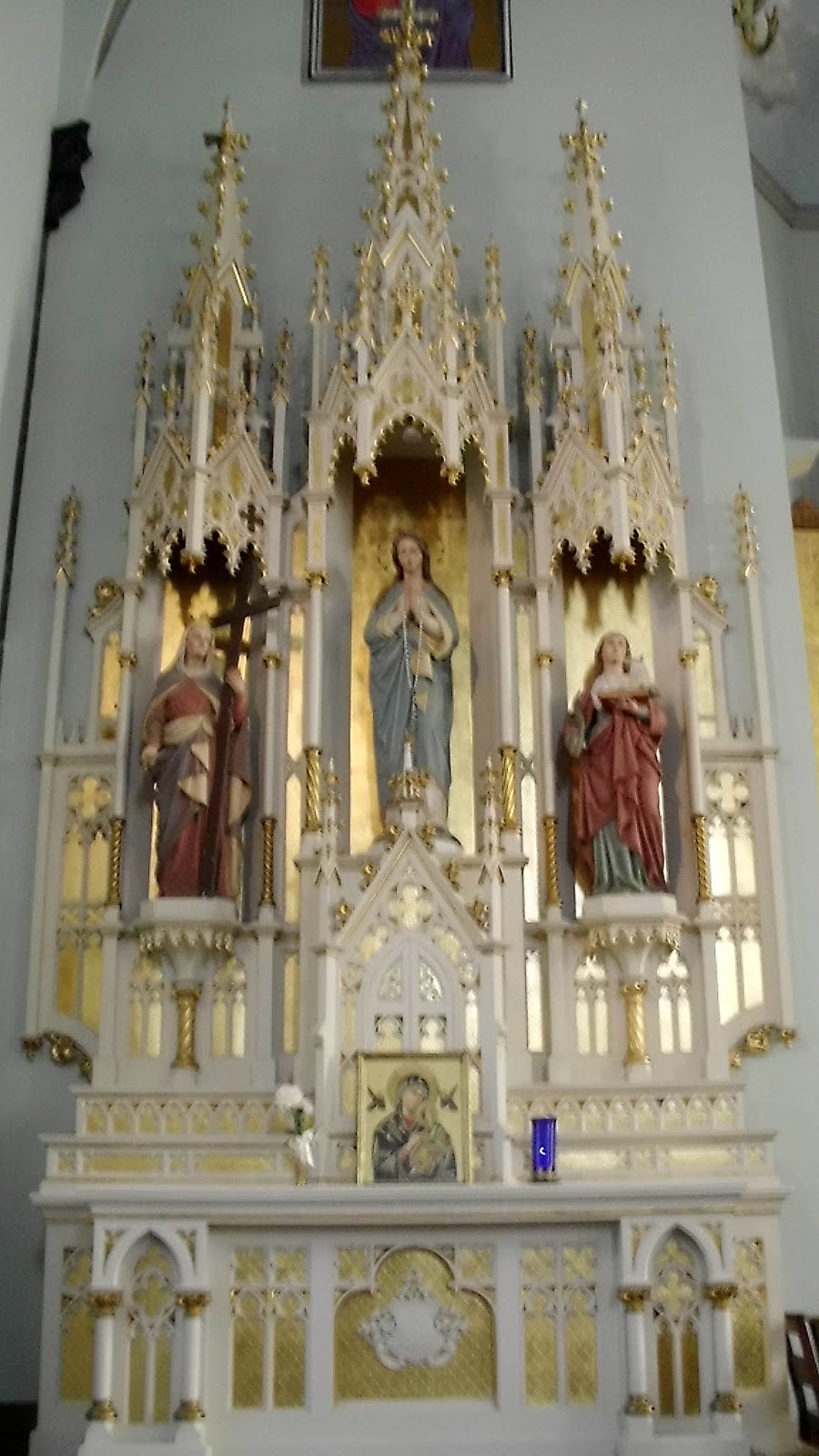
All of the altars are carved from solid oak and made in a Gothic Revival style.


Mysteries of the Rosary are painted on the ceiling. The Presentation in the Temple and the Finding of the Child Jesus in the Temple are portrayed below.

On July 22, 2014, the church was subject to an arson. An arsonist ignited linen on the altars but, thankfully, the damage inflicted was minimal.


Within the next year, the altars and murals were restored.
Source

There have been 16 pastors in the history of St. Michael Parish. Fr. Philip Ching, the current pastor, has led the parish for the past three years. He is assisted by Deacon Tracy Esper.

Daily Mass is at 8:15am on Mondays and Fridays. On First Fridays, the Blessed Sacrament is exposed for Adoration, after morning Mass and until 7:00pm. The Sacred Heart prayer group meets at 6:00pm on Tuesdays.

The Sacrament of Reconciliation is offered on Saturdays, 3:30pm-4:45pm, and by appointment.

Saturday Vigil Mass is 5:00pm while Sunday Masses are at 8:30am and 10:30am.

Our Lady of Fatima stands in a garden between the church and rectory.


More info: parish website + parish history + photos
More about Fr. Ching: The Michigan Catholic

Monday, August 20, 2018

St. Irene Church (St. Gabriel the Archangel Parish, Ida)


Settlers arrived in the village of Dundee as early as 1823, however, St. Irene Parish was not established until 1964.


In 2013, St. Irene merged with St. Joseph, est. 1869 in Ida, to form the new parish of St. Gabriel the Archangel. At the time of the merger, there were 300 registered families at St. Irene.

Both churches, eight miles apart, remain in operation. However, the parish office has been located at St. Joseph since the merger.

St. Irene stands on one side of the tabernacle, St. Anthony with Child Jesus on the other side.

St. Joseph, with Child Jesus, and St. Gabriel the Archangel at a side altar.

The baptismal font and Paschal candle stand in front of a side altar to the Blessed Virgin Mary. Simple, red-and-blue geometric windows.

Fr. Gerard Cupple has served as pastor of St. Gabriel Parish for the last year.

Saturday Vigil Mass is at 4:00pm, preceded by Reconciliation at 3:15pm. Sunday Mass is at 10:30am. Weekday Mass is at 9:00am on Monday, Wednesday and Friday.

For more info: bulletin archive

More photos: AOD Film Services About the merger: The Michigan Catholic

Tuesday, June 19, 2018

St. Anthony of Padua (Temperance)


The cornerstone of St. Antony of Padua Church was laid n July 4, 1907, but there were three delays before construction could start. Once construction began, the edifice was finished in seven months under the director of Fr. Alphonse Bertele, Pastor of St. Joseph in Ida


The first Mass was in the church basement on November 24, 1907 and the first Mass in the sanctuary was the following Christmas. Fr. Denis Needham was the founding pastor and led the 87 founding families.


A statue of the namesake stands in front of the rectory. Another statue, in memory of World War II veterans, stands in front of the former parish school.


Large, painted Stations of the Cross have faded over the course of decades.


A Perpetual Adoration chapel, built in 1989, is located in between the vestibule and main church.


A large stained-glass window was installed in the vestibule for the parish's centennial.


A baptistery stands in the vestibule between the church and parish office. The baptismal font likely stood at the back of the church at one time. Another statue of St. Anthony stands near the baptistery.


Fr. Brian Hurley was installed as pastor in 2006 and served two terms. He will soon be installed as pastor of Immaculate Conception in Lapeer and Fr. Robert Slaton will become administrator of St. Anthony.

Stained-glass window above the central door.


The stained-glass windows here are almost identical to those at St. Joseph Church in nearby Ida. The windows in both churches were likely created by the same fabricator.


The church has a vault ceiling with many arches throughout. Much like the Stations, murals behind the altars appear to have faded over time.


The Deposition of Christ overlooks the main altar. A baldachin with the Descent of Holy Spirit covers the main altar.


The Immaculate Conception and St. Anthony with Child Jesus are depicted at side altars.


Our Lady of Guadalupe and St. Thérèse stands in a niche.


Our Lady Help of Christians, the Sacred Heart of Jesus, and St. Joseph stand in another niche.


The parish manages St. Anthony Cemetery, located three miles east of the church.


For more info: parish website + The Michigan Catholic