Showing posts with label seminary. Show all posts

Tuesday, October 30, 2018

SS. Cyril & Methodius Seminary (Orchard Lake)


Fr. Leopold Moczygemba, a Conventual Franciscan and one of the first Polish priest in the U.S., petitioned the Vatican to establish a seminary in the United States. Pope Leo XIII granted approval on January 14, 1879, and Fr. Moczygemba began fundraising but had to resign due to illness. Fr. Józef Dąbrowski was soon assigned to bring the plans to fruition. Fr. Dabrowski was also pastor of St. Albertus Parish and integral in bringing Felician Sisters to Detroit in 1874.

The Felicians built a motherhouse and Guardian Angels Orphanage at Canfield and St. Aubin, a block north of St. Albertus Church. Immediately north of that, land was purchased for the Polish Seminary School of Saints Cyril and Methodius. Bishop Stephen Ryan, Diocese of Buffalo, blessed the cornerstone on July 27, 1885. Bishop Borgess and Fr. Dabrowski were present for the ceremony. SS. Cyril & Methodius was the first seminary in Michigan and the only seminary in the U.S. dedicated to educating foreign-born seminarians.
A plaque at the Orchard Lake campus depicts the first two rectors.
The cornerstone of the original seminary building is at the bottom.

Fr. Dąbrowski died from a stroke in February of 1903 but the seminary continued to grow under the direction of Fr. Witold Buchaczkowski. Around the same time, in 1908, Michigan Military Academy in Orchard Lake closed due to bankruptcy. Taking advantage of this opportunity, Fr. Buchaczkowski moved the seminary to the 125-acre campus on the shore of Orchard Lake. 
 

The seminary restructured in 1927 and separated into three schools: S.S. Cyril and Methodius Seminary, St. Mary’s College, and St. Mary’s Preparatory. St. Mary's College closed in 2002 but the other two remain active.

A Marian Grotto was added in the 1940s.
 

The former seminary building in Detroit was demolished at an unknown date and a playground on the site was named in honor of Fr. Dabrowski.


The Chapel of Our Lady of Orchard Lake was constructed in 1962, at the center of the campus, and has a capacity of 750.

Our Lady of Orchard Lake, with the school emblem on her chest, is suspended on the front facade of the chapel.


The prominent features of the chapel are inflexed arch ceiling and roof. 

A depiction of the Last Supper stands being the altar and around the tabernacle. An inverted arch reredos stands in front of a stained-glass wall.  

Stations of the Cross are likely salvaged from an older chapel.


Blue, green, and yellow stained-glass windows are seen throughout the exterior walls of the chapel.


Pope St. John Paul II visited Orchard Lake twice as a cardinal, in 1969 and again in 1976. A kayak used by the saint during his first visit is displayed in the vestibule of the chapel.

The chapel hosts the Archdiocesan Shrine to St. John Paul II. It features a portrait of JP2, a relic of his blood, his surplice, and an image of Our Lady of Częstochowa.

The campus is also home to The Polish Mission, a group that preserves and promotes Polish and Polish-American culture, tradition, and history for present and future generations. The grounds also include The Galeria. This 19th century building was designed to look like a castle, was later used as a chapel, and currently is a museum for Polish art and culture.


Adam Cardinal Maida is an alumnus of St. Mary's Prep. Fr. Miroslaw Krol, a native of Poland and graduate of SS. Cyril & Methodius Seminary, has been chancellor of the Orchard Lake Schools for the last year.

More info: seminary website + high school website + Polish Mission
News articles: Catholic News Service + The Oakland Press

Tuesday, March 06, 2018

Chapel at St. John's (Plymouth)

The plans for St. John’s Provincial Seminary were conceived in 1936 but, delayed by World War II, construction did not begin under a decade later.  Under the direction of Cardinal Mooney, St. John’s was designed with Romanesque archways, wide-open spaces, and a grand bell tower. Classes began in 1949 and St. John’s soon became the primary graduate-level seminary for training parish priests in Michigan. Seminarians even built their own golf course, Mission Hills, on the seminary grounds. They moved the rocks, dug the dirt, mowed the grass, and maintained the grounds. In order to play the course, a seminarian had to work at least 60 hours per year on maintaining the course.
A 1960 postcard shows an aerial view of the seminary
For the first few decades, St. John Provincial Seminary averaged about 200 seminarians. Enrollment dropped dramatically in the 1960s and 70s, to the point that the St. John's housed 20-25 seminarians per academic year. To help balance the budget, the golf course was leased to a for-profit manager and the public was permitted to access the greens starting in 1979. Eventually, due to low enrollment and high overhead costs, St. John Provincial Seminary closed in 1988 and was put up for sale. Graduate-level seminarians then moved to Sacred Heart Major Seminary, which was previously a minor seminary for high school and undergraduate studies.
 

In 1990, Archbishop Maida began planning the long-term use of the site and to repurpose the facility for the archdiocese. He was made a cardinal two years later then, in 1996, St. John’s Center for Youth and Family opened.  The retreat house operated for more than a decade before it was suspended by the archdiocese because of low attendance.

The site was renovated to become a banquet and conference center. At the same time, the golf course was expanded and improved. The three courses are named after evangelists: Matthew, Mark and Luke. Of course, the entire complex is named after St. John. The archdiocese has not subsidized general operations at the site since late 2009.

The chapel has become a popular place for weddings and ceremonies in the chapel must be according to the Catholic Rite. Revenues from a hotel, conference center and golf course on the property provide enough funds for the archdiocese to maintain the property and to provide a subsidy to its wedding ministry. A balcony that overlooks the chapel, which was once likely used by the rector of the seminary, is now used a bridal suite and private dressing room.

Our Lady of the Rosary and St. Joseph stand outside the main doors to the chapel.
 

Like many seminaries and monasteries, the chapel features antiphonal seating for group prayer such as the Divine Office/Liturgy of the Hours. 

Bronze Stations of the Cross line the walls of the nave.
 

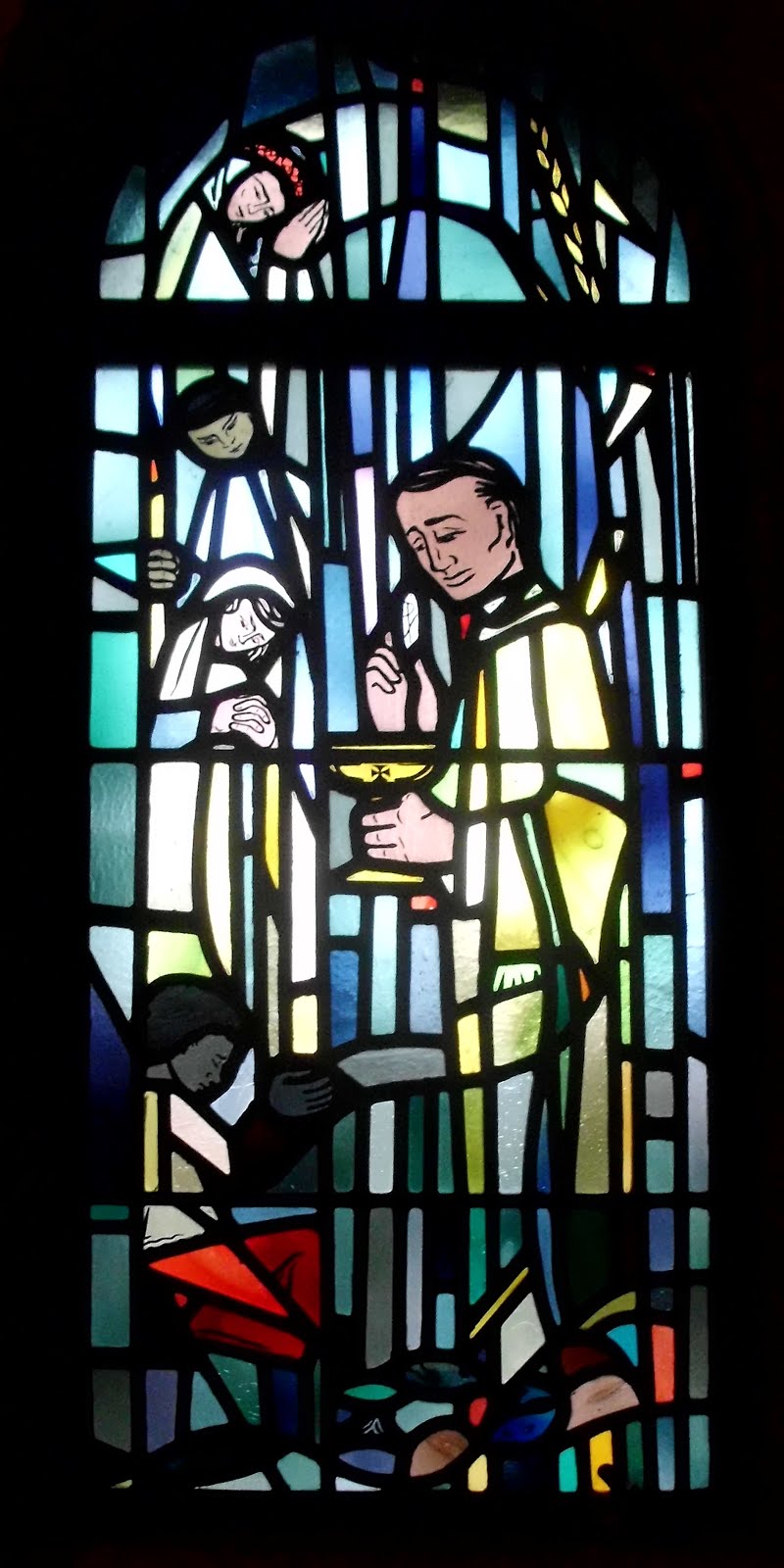
Contemporary stained-glass windows are likely to be replacements from the 1970s.
 

Christ the Eternal High Priest is depicted above the altar.

The tabernacle stands in the right transept. An inscription here recalls the words of Our Lord to St. Margaret Mary Alacoque:  "Behold the Heart that has so loved men that it has spared nothing, even to exhausting and consuming Itself, in order to testify to Its love; and in return, I receive from the greater part only ingratitude, by their irreverence and sacrilege, and by the coldness and contempt they have for Me in this Sacrament of Love. But what I feel most keenly is that it is hearts which are consecrated to Me that treat Me thus."

A statue of the Blessed Virgin Mary stands in the left transept; view of the open truss ceiling.
 

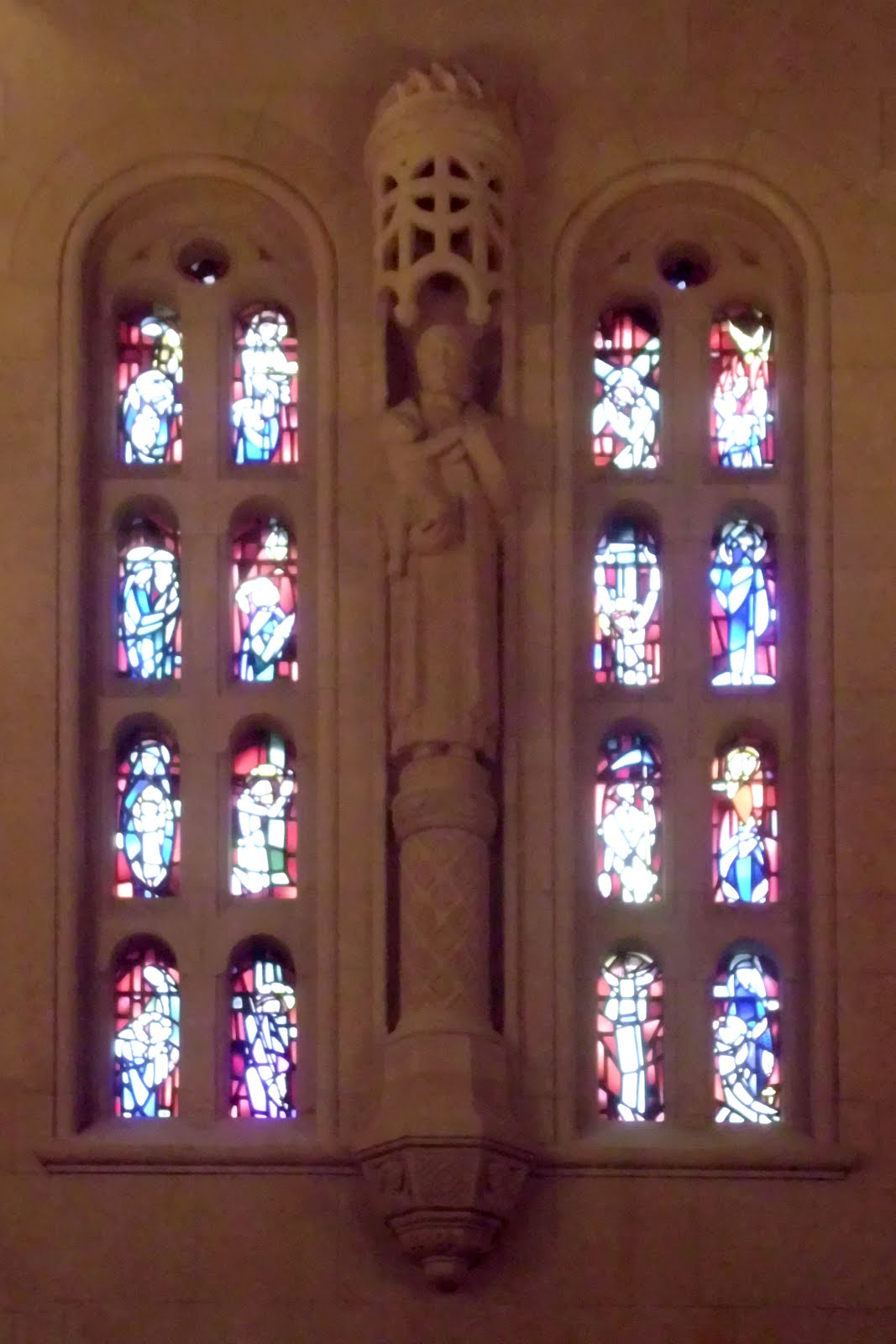
Statues and small, stained-glass windows over each transept.
 

For more info: Archdiocese of Detroit + The Inn at St. John's
Articles about the redevelopment: The Michigan Catholic, Crisis Magazine, Detroit Free Press