Showing posts with label Donaldson & Meier. Show all posts

Wednesday, December 02, 2015

St. Vincent de Paul Church, Pontiac (St. Damien of Molokai Parish)

An image of the church in its original condition is displayed in the narthex
One of the first parishes in Oakland County, St. Vincent de Paul, was established in 1851. The original church was located on North Saginaw Street in Pontiac. Fifteen years later, the parish moved to a new location at Oakland & Lafayette. The parish continued to grow and, in the early 1880s, the parish decided to move again.

Fr. Fridolin Baumgartner led a fundraising effort to build a new church and hired the Detroit architecture firm of Donaldson & Meier to design the church. The cornerstone was laid on September 6, 1885, about a mile southeast of the parish's original location.

The church was dedicated two years later, on September 18, 1887. A three-ton bell was installed in the church in 1890. A rectory was constructed in 1895, a school building was added in 1897 and a parish hall in 1911. The school was replaced with another structure in 1923 and a convent was added in 1926. The school eventually closed in 1969.

The church is located at 46408 Woodward, on the northbound, east side of Woodward in Pontiac. It was designated a Michigan State Historic Site in 1987 and listed on the National Register of Historic Places two years later.

St. Vincent de Paul initially clustered with two other Pontiac parishes: St. Michael (est. 1919) and St. Joseph (est. 1923). In 2009, the three parishes merged to form St. Damien of Molokai Parish. Fr. James Kean has been pastor since the merger and Fr. Jacob VanAssche joined as associate this past summer. They are assisted by Deacon Brian White.
        

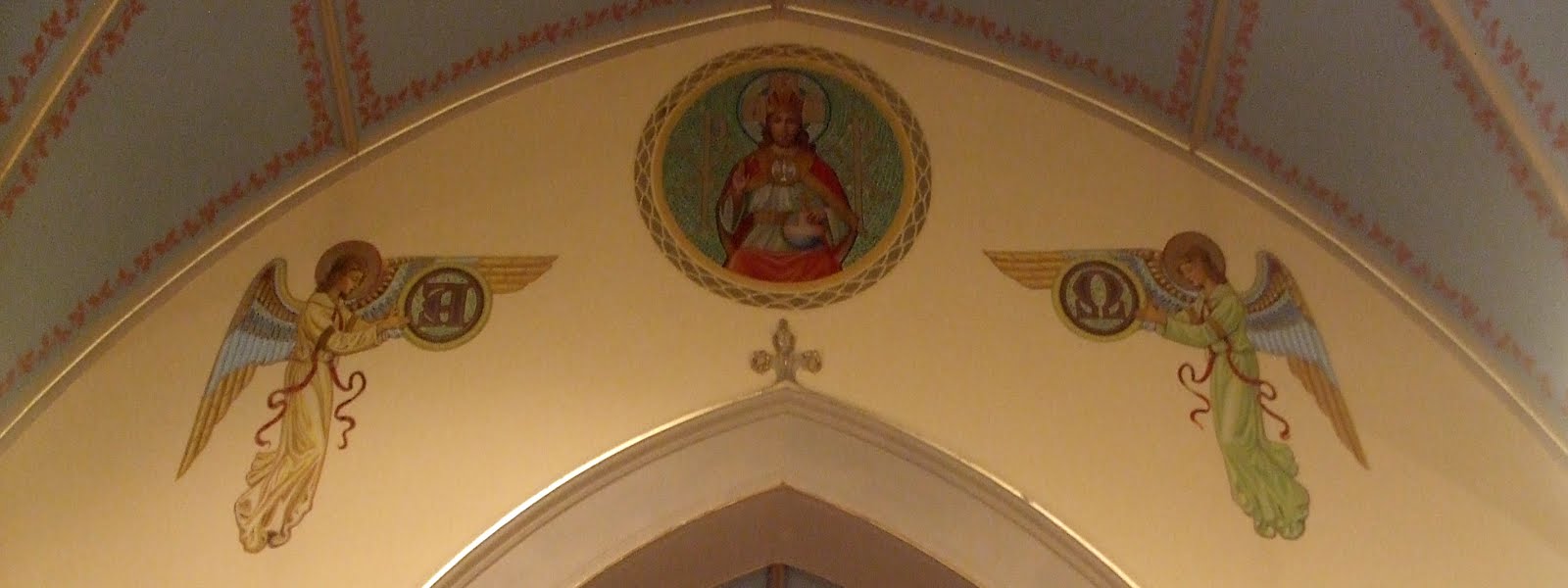
Symbols of the immortality of Christ, the alpha (A) and omega (Ω), are found throughout the church, inside and out. These are found on the front doors as well as on the baptismal font, in the narthex, and above the altar.


Much of the interior is designed in a Neo-Gothic style: tall, narrow, pointed arches and elaborate wood carving.
 

St. Vincent de Paul and St. John the Baptist stand inside the high altar.

Side altars dedicated to the Sacred Heart of Jesus as well as the immaculate Heart of Mary

The tall, narrow windows feature depictions of plants.


Intricate motifs surround all of the trim; rosary beads line the edges of the archways.
  

A mural of the parish's patron in the south transept. 

A large crucifix and St. Mary Magdalene are also there, opposite a copy of the Pieta.
 

A rose window adorns the north transept

Sunday Mass, in Spanish, is at 9:00am and 7:00pm. Mass in English is at 11:00am Sundays as well as Noon on Wednesday, 9:00am on Friday, and 4:30pm on Saturday.


For more info: bulletin archive + wikipedia
About the merger and pastor: vicariate news
About 2010 renovations: Oakland Press


Wednesday, June 24, 2015

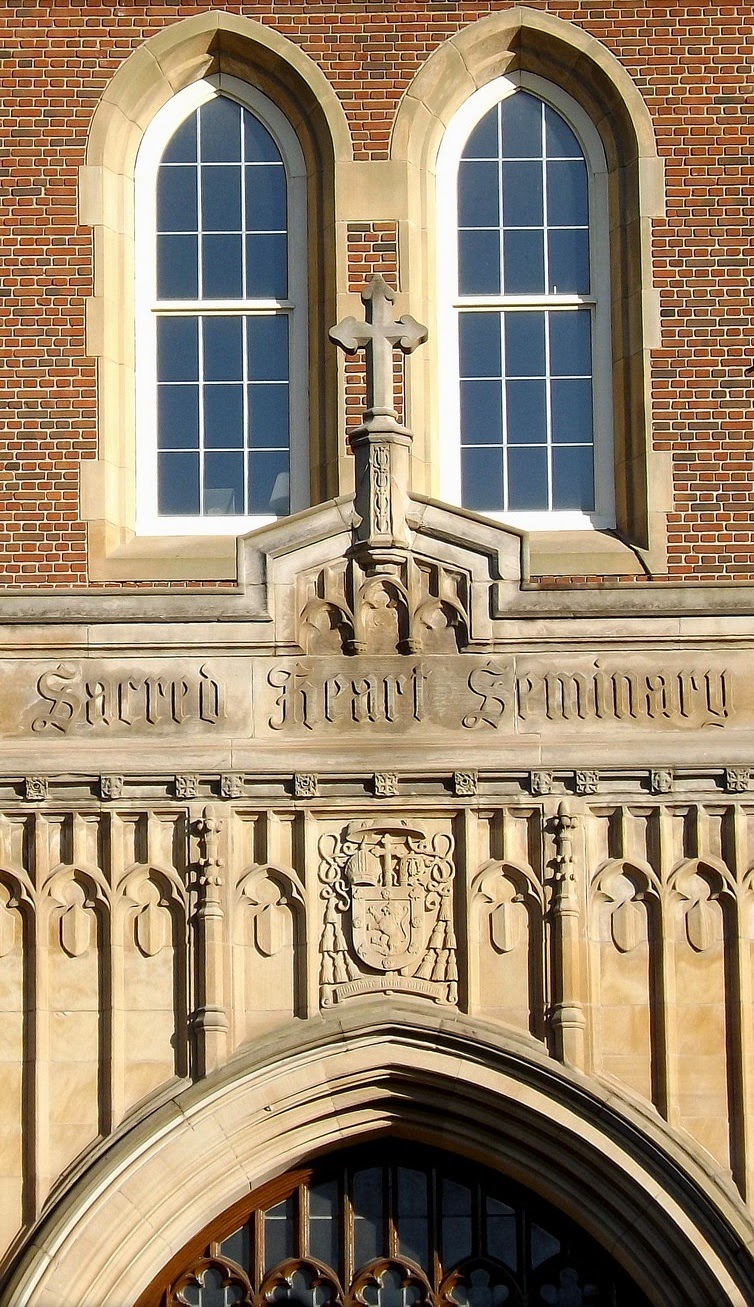
Sacred Heart Major Seminary


Sacred Heart Major Seminary was established in 1919 and the current structure was built four years later. Construction of the building was funded by prominent Detroit families such as the Fishers, Crowleys and Van Antwerps. It was designed in the English Tudor Gothic by the firm of Donaldson & Meier. 


The floors of the main level and chapel are covered with Pewabic tile. A "Sedes Sapientiæ" or "Seat of Wisdom" statue stands outside one of the libraries.
 

A large crucifix hangs near the chapel entrance of the chapel.
 

The tabernacle stands in the east transept of the chapel.


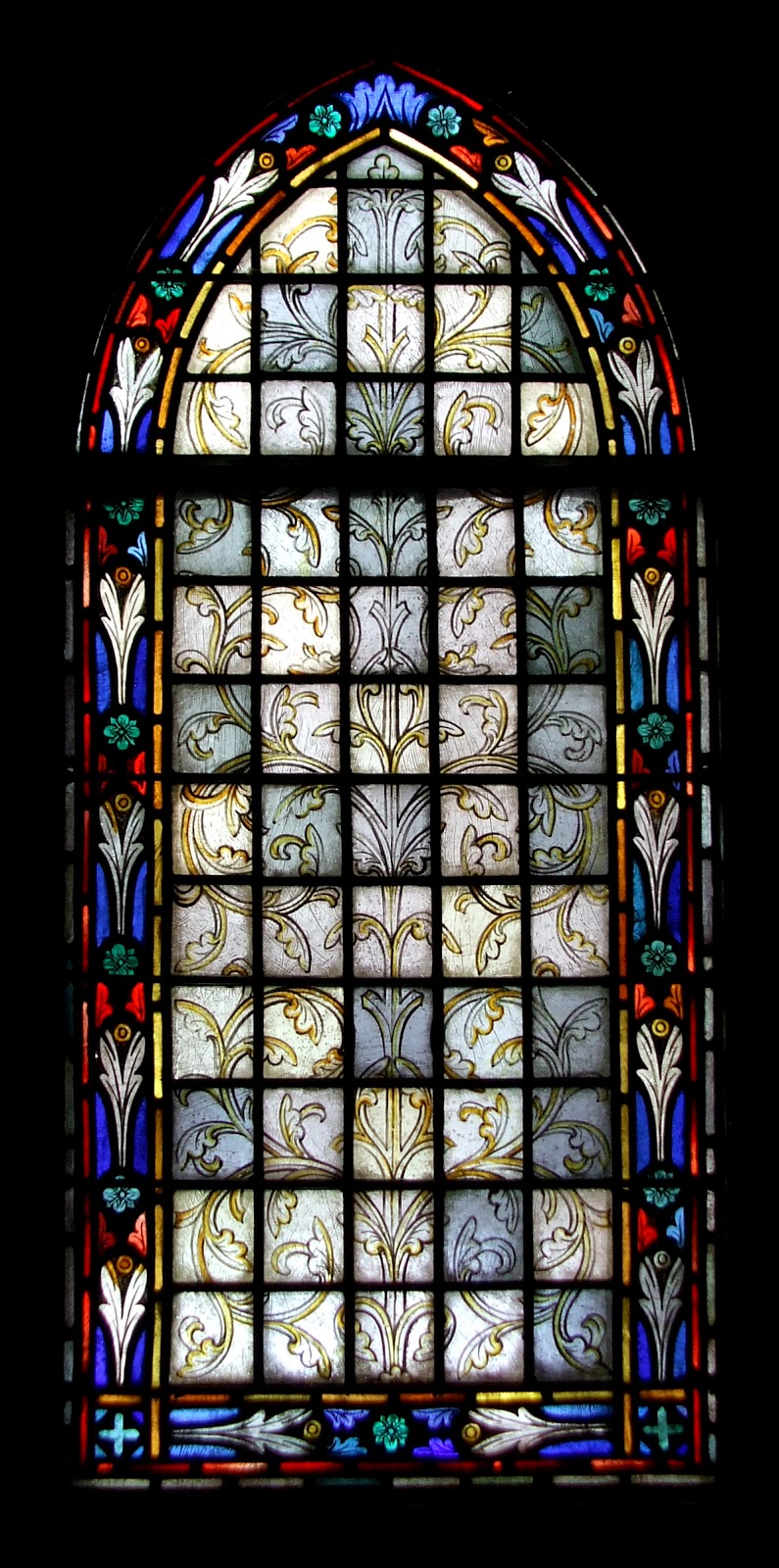
Stained-glass windows were designed by Margaret Bouchez Cavanaugh.


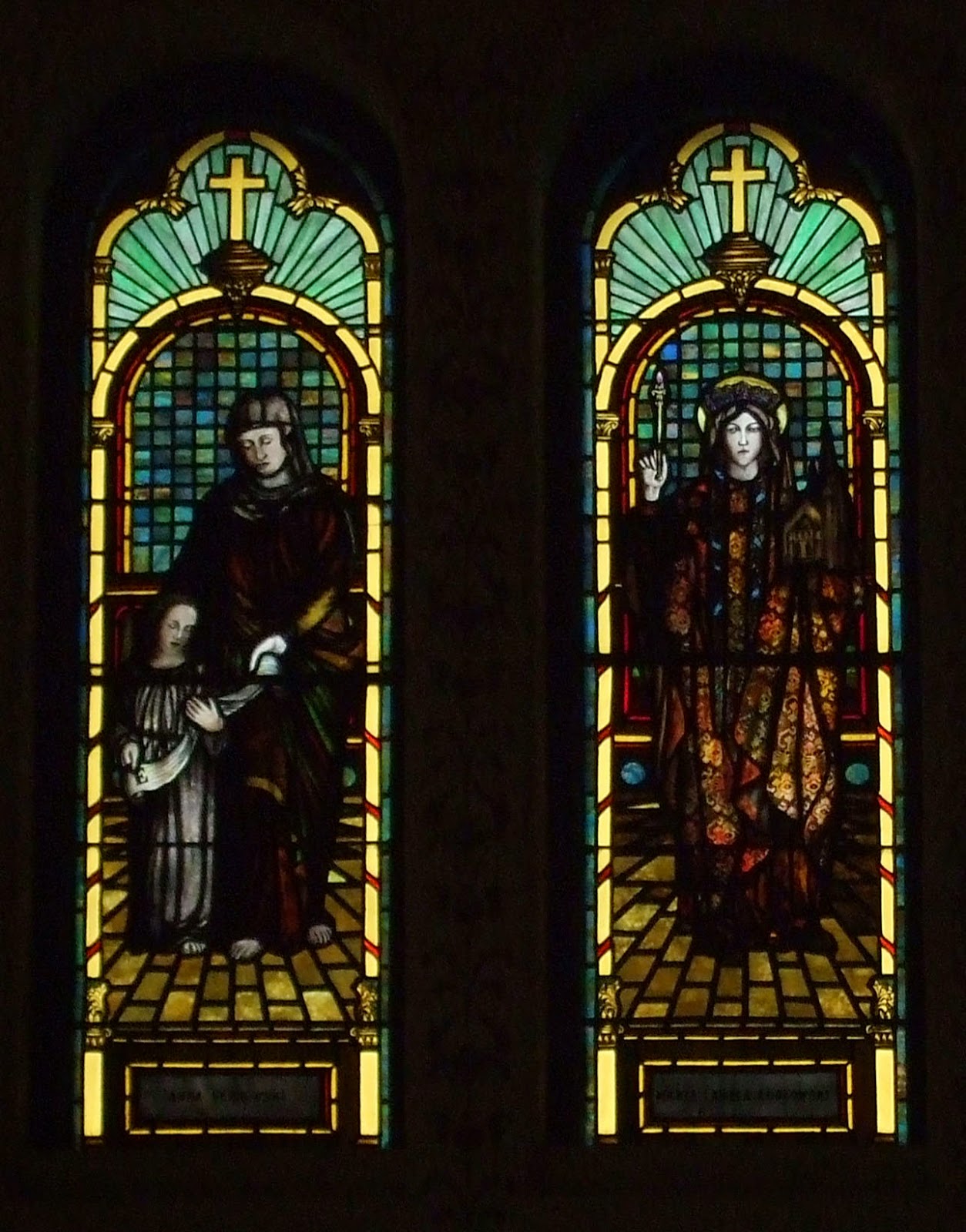
Clerestory windows show noteworthy saints, including St. Gregory the Great (left) and St. Stephen the Protomartyr.


A side altar to the Blessed Virgin.


The high school closed in 1970 and only the college level remains.


The seminary is located at West Chicago and Linwood, at the western edge of the Boston-Edison historic district.

For more about the seminary: http://www.shms.edu/
For more photos: Flickr + AOD Film Services

Monday, November 17, 2014

Return to St.Hyacinth Church


At the beginning of the 20th Century, as parishioners from St. Albertus slowly moved away, Polish immigrants petitioned for another parish. In 1907, the parish of St. Hyacinth, known in Polish as Święty Jacka or Święty Jacek Odrowąż, was established with Fr. Sylvester Kolkiewicz as the founding pastor. The first Masses were held at the home of Martin Tesmar, one block south of the eventual, permanent site. The first church was built in only sixteen days, in December of 1907, and located where the parking lot is today.


A combination church and school was built in 1908 and it still stands today. Felician Sisters staffed the new school under the direction of the first principal, Sr. Mary Celine. The current church is dated to 1922 and was designed by the firm of Donaldson and Meier, architects of many Detroit churches.


Msgr. Stefan Woznicki was appointed pastor in 1936 and elevated to auxiliary bishop two years later. Despite his responsibilities as an active bishop, Woznicki maintained pastoral duties for the next fourteen years.


An outdoor Marian shrine, dated to 1966, commemorates 1,000 years of Christianity in Poland. In 1981, nearby Immaculate Conception was forced to close. After this, many of their parishioners moved to St. Hyacinth. The parish high school closed only ten years after the first graduating class. In 1990, the elementary school followed suit and the remaining Felician Sisters left the parish. To this day, the former school building is still used as a social hall.


In 2002, the church underwent a massive restoration. Major cleaning and repairs to the canvas, statues, walls and stained-glass windows were accomplished. The cost of the painting alone was $120,000.


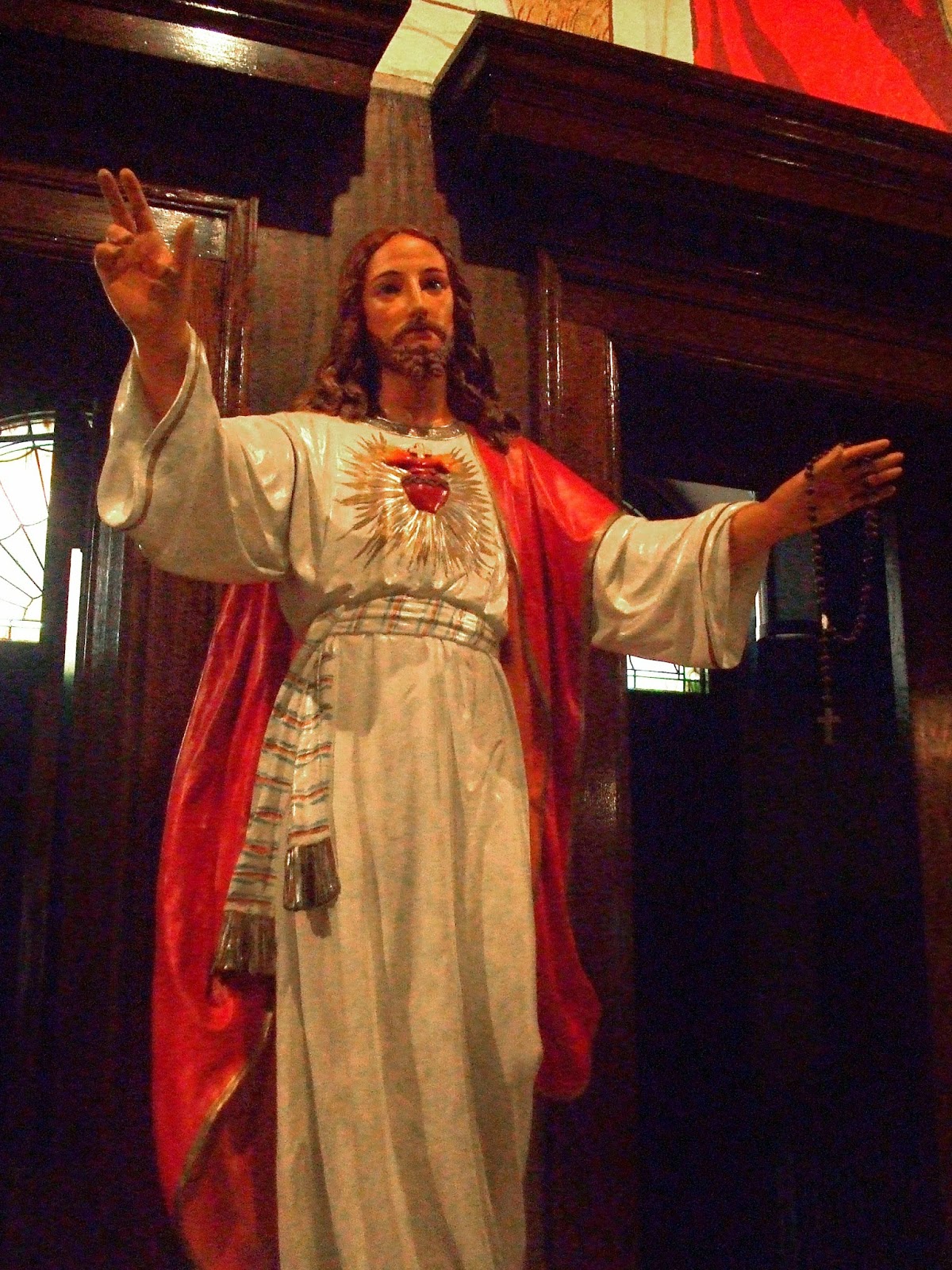
The Sacred Heart of Jesus stands at the middle entrance, flanked by a Polish flag, a U.S. flag, and logo for Detroit's tricentennial.


The sanctuary is well-preserved and one of the most elaborate of any church in Detroit.


Fr. Janusz Iwan, a Polish-born priest, has served as pastor since 2006.


The Last Supper is engraved on the facade of the freestanding altar.


Three cupolas are found in the ceiling of the nave, each showing particular saints around the perimeter.


Icons of saints, particularly the evangelists, surround each cupola. Corinthian columns line the side aisles.


Reflecting their Polish heritage, images of Our Lady of Częstochowa and Pope St. John Paul II appear in front of the left side altar.


St. Joseph, St. Francis of Assisi, and St. Anthony of Padua also stand at the same shrine.


A large crucifix and Infant of Prague stand near the right altar.


St. Stanislaus, a martyr and the first Polish-born bishop, appears in the left side of the nave near a Marian shrine.


St. Maximilian Kolbe appears in the right side of the nave, near a shrine to the parish's patron.


Dennis Orlowski, a local artist of Polish descent, was commissioned to paint a mural depicting the Polish ancestry of the parish. On one side, it shows historic Polish churches of the Poleton neighborhood. Another side depicts Polish customs such as a Wigilia.


St. Hyacinth is regularly included in historic church tours and was the first to host the Detroit Mass Mob.


The parish has some unique, annual traditions. In the spring of each year,  St. Hyacinth hosts a Mass to celebrate Polish for dance groups with as many as 200 dancers in attendance. The parish "Banana Festival" is held the first weekend of October every year. 


The parish website includes a robust history report and detail hagiography of the patron.

We previously featured St. Hyacinth three years ago.