

Fr. Richard also built a log chapel, “petite chapelle”, on the south bank of the Clinton River. The congregation quickly grew and more priests arrived. Among them were Fr. Stephen Bodin (the first priest ordained in the United States), Fr. Vincent Bodin, Fr. F. Boehm and Rev. Philip Janviers. Fr. Richard was elected to U.S. Congress in 1823 and Fr. Philip DeJean succeeded him at the mission. Fr. DeJean soon established another mission, St. Francis de Sales, on land donated by Ignatius Moross, in modern-day Harrison Township.
In 1839, Christian Clemens, the founder of Mount Clemens, plotted out a new section of the village. o encourage the sale of lots in this district, Clemens donated land to several denominations and specified that the donations were to be used for religious purposes. A delegation of thirteen men approached Bishop Lefevere of the Diocese of Detroit and received permission to build a church on the land. The deed was finally registered on September 15, 1841, and St. Peter Church was established on New Street. Bishop Lefevere assigned the first resident pastor, Rev. J. Kenny, in 1843.
 |
| The first edifice of St. Mary School and St. Peter Church. |
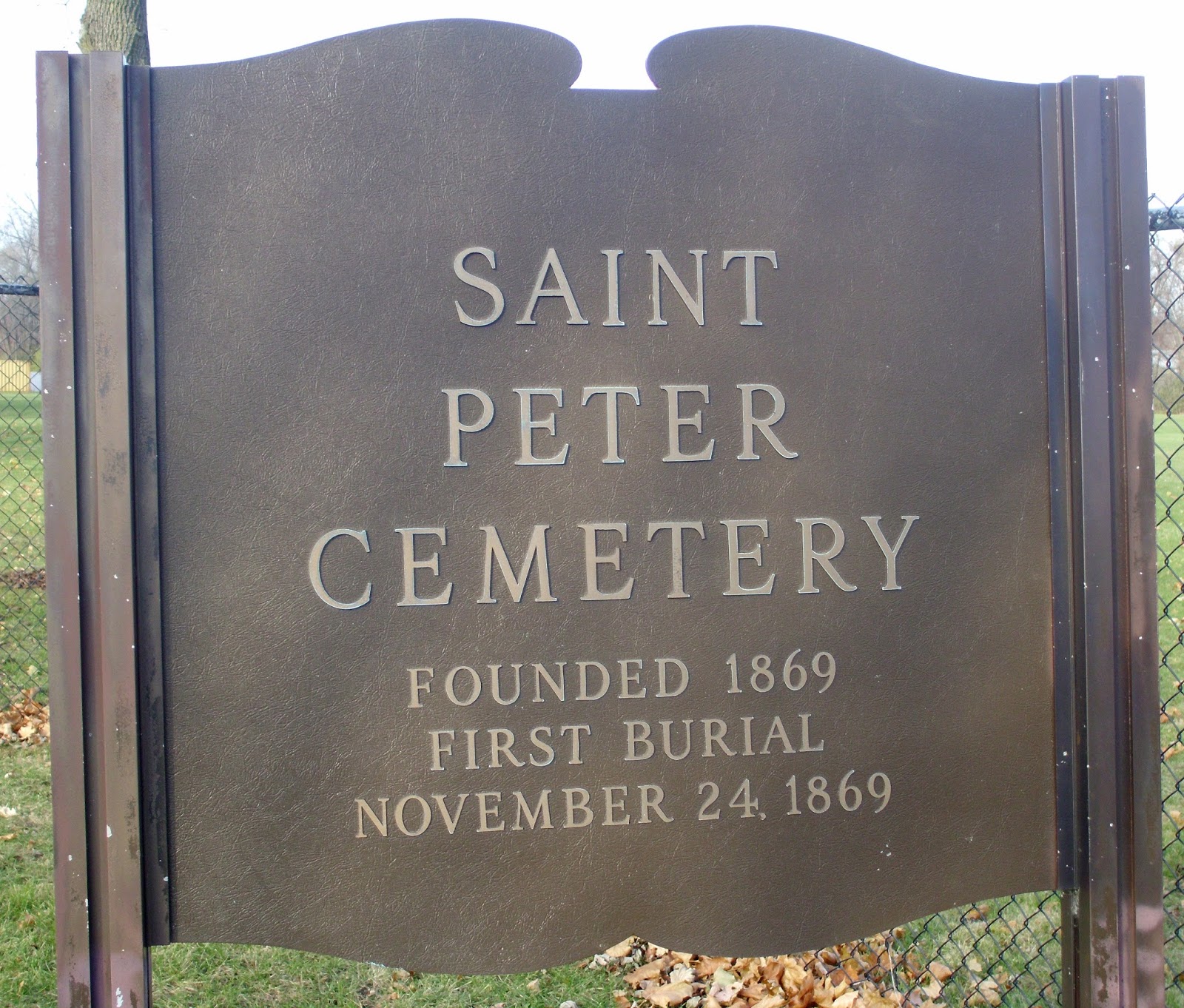
Fr. Henry Van Renterghem was assigned pastor in 1846; he merged St. Francis de Sales and St. Peter into one parish and he also established a one-room school with one teacher. Fr. Van Renterghem died on November 20, 1869 and was the person buried in the parish cemetery four days later. Hundreds of parishioners and several pastors were later buried at the cemetery.



Fr. Camillus Maes was appointed successor and later became the third Bishop of Covington, Kentucky. A new school opened in 1870, staffed by three IHM Sisters, and was named St. Mary school because the IHM requested that it be named after the Blessed Mother. This school had two rooms: one for boys and one for girls.
 |
| An 1881 map of Mt. Clemens |
In 1871, Fr. Maes was called to establish a new parish and was replaced by the Fr. Charles Ryckaert. The new pastor would eventually build a new rectory, larger school and a Gothic Revival church. The cornerstone of the new church was laid and blessed on July 4, 1882, and Bishop Borgess dedicated the new church on November 18, 1883.

Fr. Ryckaert began construction of a new convent but died in 1892, before the convent was finished. Fr. J.A. Van Hoomissen succeeded as pastor in May of that year and finished the construction projects.
 |
| The convent for Sisters, Servants of the Immaculate Heart of Mary |
 |
| St. Joseph Sanitarium, pictured shortly after it opened |
In 1895, the first graduating class of St. Mary High School consisted of seven girls. At the request of Fr. Van Hoomissen, Sisters of Charity came from Cincinnati to establish St. Joseph Sanitarium in 1899. Fr. Van Hoomissen passed away in 1902 and was replaced by Fr. Cornelius Kennedy.
 |
| St. Mary students pose with an unidentified priest (likely Fr. Kennedy) in 1909 |


Fr. Dennis Hayes was installed as pastor in 1926 before he was reassigned to Marine City in 1934 and replaced by Fr. Alfred Heber. Fr. Leo Roberge arrived in 1942 but died two years later. Fr. Paul Heenan was appointed pastor in 1944 and remained at the parish for over two decades.
 |
| Exterior of St. Peter Church, pictured circa 1940. |
On the morning of Wednesday, September 11, 1957, St. Peter Church was devastated by fire. The steeple collapsed and caused significant damage to the school. Firefighters from Mount Clemens, Harrison Township, Selfridge Air Force Base, Roseville, Chesterfield and Clinton Townships saved the other buildings. In less than an hour, the church fire was extinguished but the church was beyond repair.
 |
| The steeple of St. Peter collapses on September 11, 1957. |
Fr. Heenan led the construction efforts for a new church, which was dedicated on December 20, 1960.
 |
| The groundbreaking ceremony for the current church. The cornerstone was blessed and settled. |

St. Peter Parish opened a Perpetual Adoration chapel in 1984. Fr. Welch died in October of 1987; Fr. Joseph Femminineo was named administrator and, subsequently, pastor. The parish had significant debt at the time and two buildings were beyond repair. IHM Sisters left the parish in 1988, after 118 years of service at St. Mary School. On July 5, 1989, the convent became the rectory and administration building. Fr. Femminineo started to reduce the parish debt, renovated the Perpetual Adoration Chapel and tore down the old convent and rectory.

Fr. Michael N. Cooney arrived as pastor on August 1, 1990, and remains pastor today. After two years of negotiating, the parish purchased the former Alexander Macomb School from Mount Clemens Community Schools. The new St. Mary School was dedicated in September 2013.

The former St. Mary School was demolished this past July and a crew is still removing debris from the site.

St. Peter stands on Market Street, in front of the church and parish hall; the baptismal font stands in the rear of the nave.


A display case in the church vestibule exhibits artifacts from the parish's history: an altar card, a missal, prayer book, section of a window, door handles, a flourish of a spire, etc.

Stained-glass windows depicting the Baptism of the Lord in the former baptistery, now where the restrooms are located.


The Keys of St. Peter at the foot of the altar; the 14th Station of the Cross


Stained-glass windows in the cry room depict Madonna and Child and Our Lord with a child.

A brass baldacchino covers the high altar; the words "holy, holy, holy" and symbols of the Eucharist adorn the facade.

The Infant of Prague and Sacred Heart of Jesus flank the sanctuary.


The traditional side altars to the Blessed Mother and St. Joseph, respectively.


St. Paul stands in the southeast (left) transept; St. Peter in the northwest (right) transept.


St. Joseph Sanitarium still stands today, half a mile north of church and next to Henry Ford Macomb Hospital. It is registered Michigan Historic Site, the last remnant of the once many bath houses in Mount Clemens.


St. Peter Cemetery stands 1.5 miles north-northwest of the church.


A section of the cemetery is dedicated for deceased priests from the parish.


More info: parish website + school website
More about St. Joseph Sanitarium: Macomb Daily
More photos: AOD Film Services
St. Mary's School demolition: WXYZ + Macomb Daily


