Showing posts with label St. Joseph. Show all posts

Sunday, December 31, 2017

St. Joseph Church (St. Vincent Pallotti Parish, Wyandotte)

Most of the early immigrants to Wyandotte were of Irish descent. However, German-Americans began to move in the 1860s. Men from the St. Boniface Society, a Catholic-German fraternal organization, petitioned Bishop Borgess to establish a German-American parish in Wyandotte. Bishop Borgess granted their request in 1870 and established St. Joseph Parish. However, the bishop warned that he would not assign a priest until the congregation built a church and rectory.

The congregation pooled their resources — money, building supplies, skilled labor — to build a church and rectory on the southeast corner of 4th and Elm Streets. A brick church was built at a cost of $8,000 and included a tall steeple and an attached rectory.

Construction was completed the following year and Fr. Leonard Unterreiner arrived as the first pastor. St. Joseph Church was dedicated on November 5, 1871. For fifteen years, 1873-1888, one priest staffed both St. Joseph and nearby St. PatrickFor several years during the 1890s, the parish was served by several Capuchin priests. Fr. Jerome Hieronymous, a Capuchin, raised the funds to build a school which was then dedicated in the early 1890s.

The school was built on the south side of Elm Street. The Sisters of St. Agnes of Ford du Lac, WI were the first teachers, followed a few years later by the Adrian Dominican Sisters, who remained with the school for many years. Originally, classes were taught in both English and German.

The first rectory burned down in 1881 and was replaced by another rectory, further away from the church. When the church first opened, it heated by only one potbelly stove. The church relied and natural light and candlelight before it was wired for electricity in 1905. In 1916, lightning caused a fire in the original spire of the church, which ruined it and resulted in considerable water damage to the interior of the church. A much smaller square cupola replaced the spire. Another rectory, measuring 6,500 square feet, was built in 1918 at a cost of $15,000.

Construction of a larger school  began in 1939, less than a block south of the church. Classes were soon held in the unfinished school but World War II delayed its completion in 1949.


By the early 1950s, St. Joseph Church needed many repairs and the congregation had outgrown it. Fr. Albert George ordered it torn down in 1951 and Masses were held in the gymnasium of the school. The arrival of Fr. Walter Hennes in 1954 prompted a capital campaign to construct a new church. The first step was the purchase of the Arbeiter Hall, a German blue-collar workers’ assembly hall. This is the land on which this church now stands across the street from the first church. Ground was broken on the new edifice in 1958 and they new church was dedicated in May, 1960.

In 1961, Fr. Joseph Bohr became pastor and led the parish through the years of Vatican II until he was replaced by Msgr. John Weier in 1978. Cardinal Szoka assigned Pallottine Fathers to St. Joseph Parish in 1990, under the direction of Fr. Gerry Frawley. The Pallottines had been in Wyandotte since the 1950s but ministered at other parishes. Fr. Michael Cremin, SAC, was assigned as pastor in 2004 and remains there today.


St. Joseph School merged with St. Patrick School and St. Elizabeth School to form Wyandotte Catholic Consolidated Elementary School before it closed in 2011. The school building is still used for religious education classes.
 

In 2010, St. Joseph clustered with St. Patrick (est. 1857) and St. Elizabeth (est. 1924).  The final Mass at St. Elizabeth was on June 30, 2012.  At the time of the closure, there were 75-100 families at St. Elizabeth.
Bishop Francis Reiss celebrated the closing Mass at St. Elizabeth.
Fr. Cremin stood next to him, at his right side. - Source

The two remaining parishes merged in 2013 to form St. Vincent Pallotti Parish, patron of the Irish Pallotine priests who minister to the parish. A statue of the patron stands in a niche near the back of the church.

The old rectory was torn down in 2015 because of high maintenance and health concerns. Below are street view images from 2013 and 2017, respectively.
 

St. Alphonsus Liguori on the facade of a side entrance. A statue of St. Elizabeth of Hungary was transferred from the shuttered St. Elizabeth Church and currently stands inside a niche.
 

Two sets of tall, narrow windows flank the tabernacle. St. Michael the Archangel is depicted on the right side. Madonna and Child are shown on the top left while a family is depicted in the bottom left.

Symbols of the sacraments surround the crucifix and tabernacle.


Side altars to the Blessed Virgin Mary and St. Joseph, respectively.
 

The Sacred Heart of Jesus and St. Anthony of Padua on the back wall.
 

Clusters of steel, conical chandeliers illuminate the nave. 

The front facade shows four depictions of St. Joseph. The largest and highest shows St. Joseph holding two doves (the Presentation at the temple) and his flowering staff. The other three images show, from left, the Flight into Egypt, the Nativity of Our Lord, and Christ Child at work with St. Joseph. 

More about the parish: STVPP.org
More photos by AOD Film Services: St. Elizabeth St. Joseph

Articles by The News Herald:  three-parish cluster St. Elizabeth closes

More about the Irish Pallottines: IrishPallottines.org
Articles from The Michigan Catholic: October 2011 + March 2016

Wednesday, October 11, 2017

St. Joseph Church (St. Gabriel Parish, Ida)

Ida Township was organized in 1837 and named after Ida M. Taylor, a local civic leader. The small town of Ida was platted in 1868, on the northern edge of the township, and St. Joseph Parish was founded the following year. The current church was built in 1904, near the center of Ida.
St. Joseph Church as it appeared in 1907; attributed to Paul Petosky. Source
Fr. John LaCasse arrived as pastor in 1989 and continued in that role until he was forced to retire due to illness in 2008. Fr. Michael Woroniewicz, then pastor at St. Irene in Dundee, took over as pastor of both parishes in a new cluster. At the time, St. Joseph had 400 families while St. Irene had 300.

In 2013, St. Joseph and St. Irene (est. 1964) merged to form the new parish of St. Gabriel the Archangel and both churches, eight miles apart, remain in operation. However, the parish office have been located at St. Joseph since the merger.
   

In addition to his responsibilities as pastor, Fr. Woroniewicz also served as Vicar of the Monroe Vicariate and as a part-time homiletics instructor at SS. Cyril & Methodius Seminary. In July of this year, was appointed Rector at the seminary and Fr. Gerard Cupple, previously at St. Mary in Wayne, was assigned to St. Gabriel.
 
St. Joseph hosts Saturday Vigil Mass at 6:00pm and Sunday Mass at 10:30am. The parish also has Tuesday evening Mass at 7:00pm followed by Confessions.
 

Six large chandeliers, three on each side, hang over the nave.

Stained-glass windows are colorful and geometric, each one features Art Nouveau flourishes and symbols of the Church.
 

The Last Supper is depicted on the facade of the high altar, along with grapes, wheat, nd seated angels. A window of the Holy Family is pictured above the altar, although darkened in this evening photo.

Contemporary sculptures of the Holy Family stand on a much older, left side altar. Wooden sculptures of Joseph and an adolescent Jesus, holding a small boat.
 

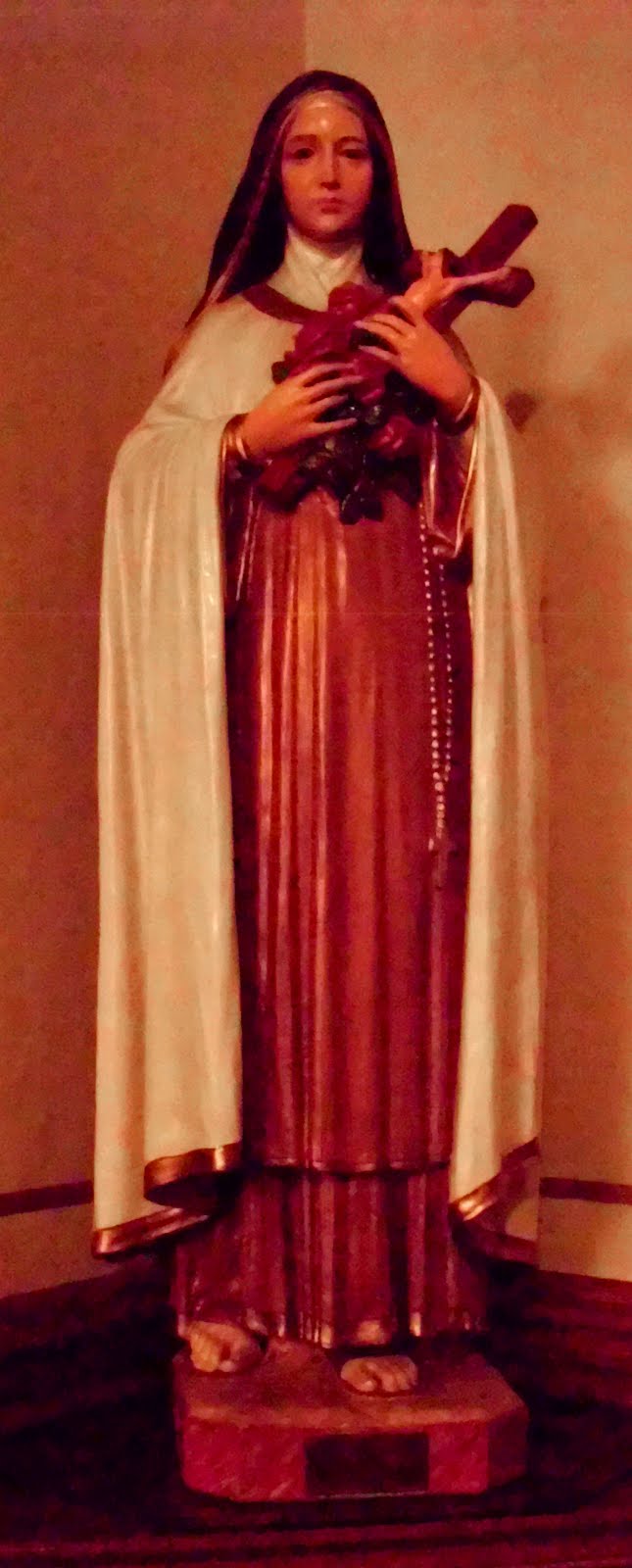
The Sacred Heart of Jesus and St. Thérèse stand at the back of the church, under the choir loft.


St. Joseph Cemetery stands about one mile south of the church. Some graves, mainly in the northeast section, date back as far as the 1870s.

Many of the founding parishioners were German-speaking immigrants
 

The cemetery is still active and includes those who passed away earlier this year. 


For more info: bulletin archive + cemetery
About Fr. LaCasse: The Michigan Catholic + Monroe News + obituary
About the parish merger: The Michigan Catholic + Monroe News
Photos: AOD Film Services

Thursday, October 05, 2017

St. Joseph Church (Erie)

An early rendering of St. Joseph Church and rectory

Around 1790, French Canadians began to settle along the western banks of Lake Erie and Maumee Bay. For two decades, Fr. Gabriel Richard ministered to the congregation at Saint Joseph de la Baie Miami. A simple log church was built on the shore in 1819 and, several years later, it was replaced by a frame structure. For two years, 1826-1828, the new church was also used a school until the school was forced to close.

The cornerstone of the current church was laid in 1851 and Bishop Peter Paul LeFevere consecrated the church the following year.

Fr. Henry Rievers made a second attempt at a parochial school in 1855. The Sister Servants of the Immaculate Heart of Mary (IHM Sisters) of Monroe staffed a two-story frame building for four years until the school abruptly closed in 1859.
The first dedicated school building for St. Joseph Parish.
A large group of men (soldiers?) stands in front of the church in 1865.
Fr. Emil Wolstyn built a convent and school in 1914 next to the church, both still stand today. The high school had its first graduating class in June 1919. Since the greatest number of graduates in any one year was eight, the high school was discontinued after 17 years.

In 1971, the elementary school was closed for the third time due to financial difficulties.

After several years of petition from parents, Fr. Robert Haener reopened the school in 1979 with classes for Kindergarten through Grade 2 with another grade added each year. This yearly expansion continued until there were Kindergarten to Grade 8 classes. A pre-kindergarten was added in 1986 and a preschool in 1992. A gymnasium and dining hall were added to the school in 1994.  The Sisters of Notre Dame from Toledo, Ohio, staffed the school for decades and one sister continues to teach there today.

St. Joseph Parish is the second oldest parish in Monroe County and the fourth oldest parish in the Archdiocese of Detroit. The church stands less than five miles from the Ohio state line.


Within the last five years, a statue of St. Joseph and Child Jesus was added in front of the main entrance.

The church's steeple was repaired earlier this year.

The beginning of the Gloria is painted above the main doorway.

Our Lady of Fatima stands next to the baptismal font while the Sacred Heart of Jesus stand next to the St. Joseph altar.

The Blessed Mother side altar.

Stained-glass windows are later additions, likely to be mid-20th Century replacements.
 

A cruciform window in a side door; St. Michael the Archangel stands at the rear of the church.
 

Throughout the church, the ceiling is covered with decorative tiles.

Tuesday evening Mass is at 6:00pm followed by Our Lady of Perpetual Help devotionsWednesday and Thursday mornings bring 8am Mass while Friday Mass is at 8:30am. Saturdays bring Reconciliation at 10:00am and Vigil Mass at 4:30pm. Sunday Masses are at 8:00am and 10:30am.
 

Fr. David Cybulski was ordained in 2009, appointed administrator of St. Joseph in 2013 and pastor in 2015. In addition to his responsibilities as pastor, Fr. Cybulski is also vicar of the Monroe Vicariate.

A parish cemetery stands 1.5 miles west of the church, on Erie Rd.


For more info: parish website

For more photos: Catholic Toledo #1 & Catholic Toledo #2