Catholics were slow to settle in Lapeer partly because, like much of the nation, many settlers had a strong anti-Catholic bias. In 1844, a visiting missionary priest, Fr. Laurence Kilroy, was pelted with stones. Despite difficulties, Fr. Kilroy sought out any Catholics living in the area. He encountered many non-Catholics who were moved by his “untiring zeal and Christian charity” and were thereby converted to Catholicism. Nevertheless, Fr. Kilroy left Lapeer, convinced that Catholics should not settle there, and went east to St. Clair.


On August 17, 1859, Fr. DeCunic, a Flint priest, persuaded Alvin Hart, founder of Lapeer, to procure property for the site of a Catholic church. Hart provided a small parcel of property on the northern boundary of the village of Lapeer on the top of a hill where, today, Calhoun and Oregon Streets meet. As Catholics were viewed with suspicion and not particularly welcome in Lapeer, this location was chosen purposely to keep Catholics on the outskirts of town.


Jerry Sullivan led the construction efforts and, by October of 1860, much of the frame was finished. However, due to the Civil War, construction was delayed. In October of 1864, Fr. John Busche, a 25-year old German missionary, was appointed pastor to the people of Lapeer. The congregation originally chose the patronage of St. Martin but eventually selected Church of the Immaculate Conception of the Blessed Virgin Mary. It was one of the first churches to bear that title after the dogma of the Immaculate Conception was promulgated by Pope Pius IX a decade earlier. The first Mass was held in the unfinished church; congregants improvised with boxes and boards because there were no pews at first.

Fr. Busche oversaw the completion of the first church, finished in 1866, and ministered to Catholics in nearby villages. He organized the faithful in Imlay City and Davison, where he built mission churches and purchased land for cemeteries. Fr. Busche also led many converts to the Faith. By 1880, according Fr. Alonzo Nacy, who grew up in Lapeer, half of the parish was comprised of converts. Construction on the current, fieldstone church began in 1895 and finished a decade later. It stands a mile south of the previous church, in what is now called Piety Hill Historic District.
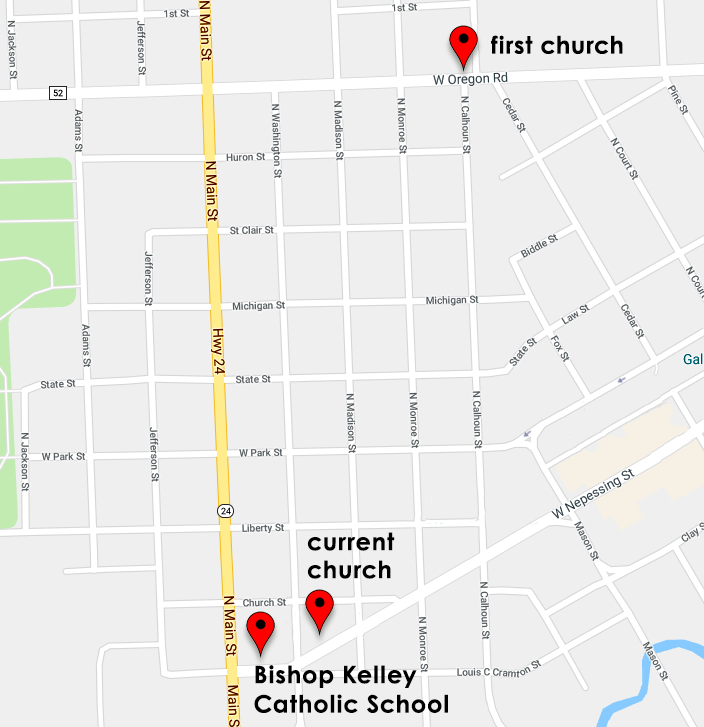
Fr. Francis Kelley served as pastor at the turn of the 20th Century. In 1924, he was consecrated as the second Bishop of Oklahoma City. He died in 1948 and, two years later, Immaculate Conception Parish established a K-8 school named in honor of him.


Bishop Kelley Catholic School remains active today and is the only Catholic school in Lapeer County.
Nearby churches such as St. Joseph the Worker in Lake Orion and St. Augustine in Richmond are also built from fieldstone.

The interior of the church features a barrel vault ceiling, pointed arches and Corinthian columns.


The parish rescued a 7,000-pound marble altar from a closed New Jersey church and installed it at Immaculate Conception in 2013.


The St. Jude statue was transplanted from a now-closed Detroit church and is believed to be the one that Danny Thomas prayed before, leading to his successful acting career. In thanksgiving, Thomas established St. Jude Children's Research Hospital.
The parish allows Perpetual Adoration of the Blessed Sacrament in the church, at the Sacred Heart altar.

Immaculate Conception celebrated its 150th anniversary in 2014 and there are currently about 2,100 registered parishioners today.

The Lamb of God is depicted in the center of a large set of windows in the west transept.

The Descent of the Holy Spirit is depicted in the east transept windows.
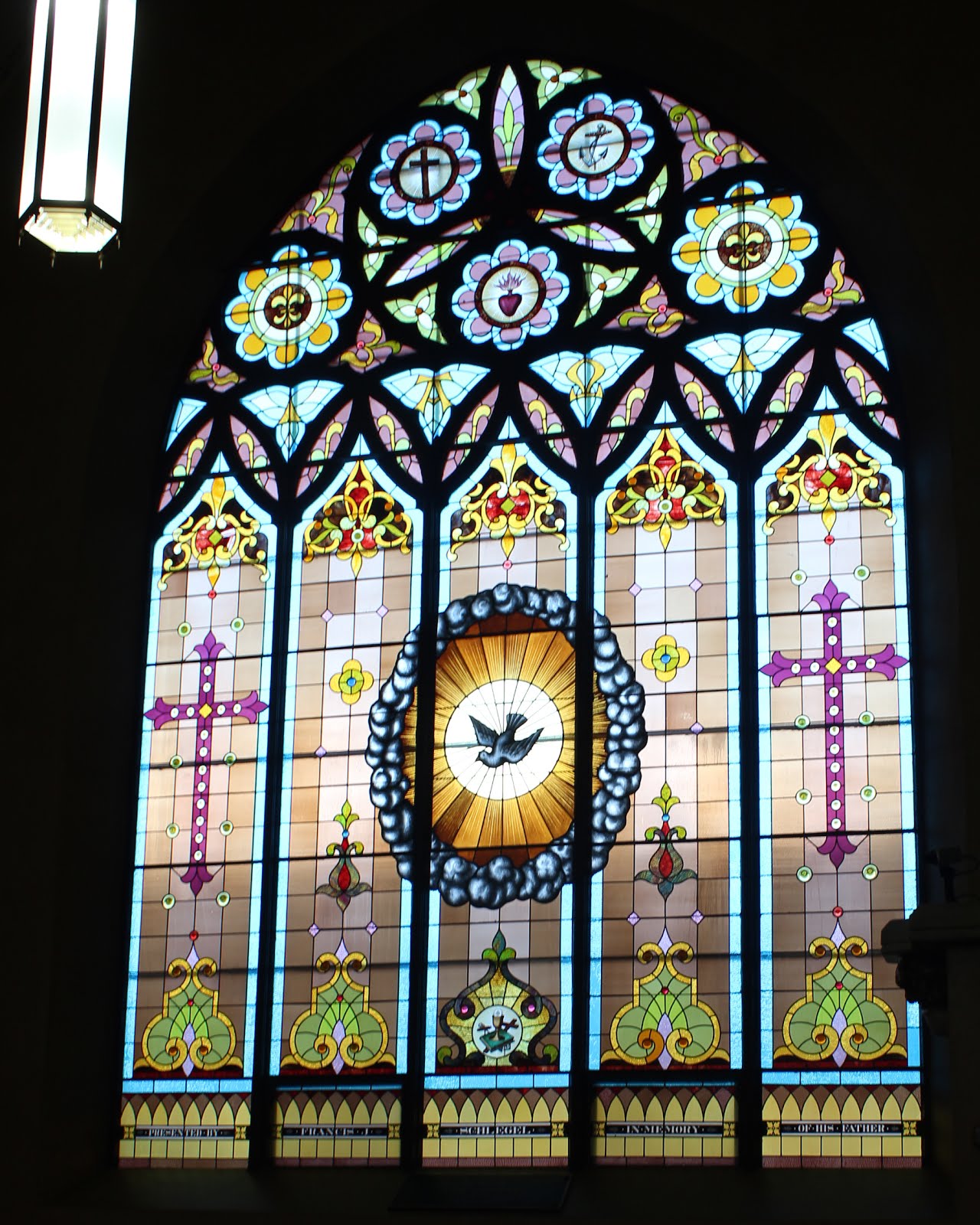
Stained-glass windows in the nave all follow the same geometric pattern with variation in colors and symbols.


The Jerusalem Cross is inlaid in the floor of the church, in front of the altar.

Fr. Joseph Tuskiewicz has been Associate Pastor for over a year. Fr. Brian Hurley, previously at St. Anthony in Temperance, arrived as pastor at the beginning of July. They are assisted by Deacon Joseph Hulway.


A Marian grotto and memorial for the unborn in between the church and rectory.


Drone video of the church exterior (with music).
Immaculate Conception Parish also ministers at St. Louise Chapel in Metamora, seven miles south of Lapeer.

Immaculate Conception also manages Mt. Loretto Cemetery, two miles south of the church.

Many of the graves date back to the late 19th Century and early 20th Century.


For more info: parish website + school website
More about the altar: The Michigan Catholic + The County Press
Another blog post: Blog Your Church