This is exciting news.
May 5th of this year will see the ordination of 2 Detroit priests as bishops to serve as auxiliary bishops.
Our auxiliaries were depleted as they were selected to run other dioceses or retired.
Nienstedt is now St Paul/Minneapolis, Blair now Toledo, Boyea now Lansing, Hurley now Grand Rapids, Quinn now Winona, and Flores is now Brownsville, TX. Gumbleton and Anderson resigned. This is just in the last 10 years.
Joining Bishop Francis Reiss in assisting Archbishop Vigneron will be Fr. Michael Byrnes and Msgr. Donald Hanchon. Both are pastors of churches featured on this blog: Byrnes of POLOV and Hanchon of Holy Redeemer. Interestingly enough, Fr. Byrnes went to the same High School and College that I did.
Diane from Te Deum Laudamus broke the news to me, and it is on the archdiocesan website.

Tuesday, March 22, 2011

Wednesday, March 16, 2011
Notes and News 3/16/2011
You may have noticed that I haven't posted in a while. I started a new job on February 28 and I am still working on the whole work/life balance. I have some activities that are finishing up so I should have more time for blogging soon.
I want to bring to your attention 2 events for this weekend:
If there are any other special things going on at your parish or a Church you like to visit, send me an e-mail at 313churchblog @ gmail or put a note in the comments.
I want to bring to your attention 2 events for this weekend:
- St. Joseph Day of Prayer at Historic St. Joseph in Detroit: There is a full day of Mass, music and devotions on Saturday March 19th for the Solemnity of St. Joseph. See the full schedule on the parish website.
- Monthly Mass at Historic St. Albertus: Mass will be celebrated in the Extraordinary form at Noon this Sunday March 20th. See the full mass schedule for 2011 here.
If there are any other special things going on at your parish or a Church you like to visit, send me an e-mail at 313churchblog @ gmail or put a note in the comments.
Friday, February 25, 2011
Immaculate Conception Lapeer - test

This is a test to see how blogging from the droid might work. this is the facade of immaculate Conception in Lapeer, MI
Tuesday, February 22, 2011
St. Hyacinth, another Polish Beauty.
This past Saturday I had the great pleasure of visiting St. Hyacinth. St. Hyacinth was founded in 1907 for the growing numbers of Polish immigrants in Poletown. Father Sylvester Kolkiewicz was the founding pastor. The first mass was celebrated in a house. In 1908 a combined church and school was built in 1908. The school was staffed by felicians. The present church, built in a Byzantine/Romanesque style was designed by the Donaldson and Meier firm and dedicated in 1924. A more detailed history is available on St. Hyacinth's website. I took much of this information written here from a pamphlet I was given by an usher after mass.
Upon entering you find that the church has been lovingly maintained and is in very good shape.
Being that the 100th anniversary was only 4 years ago, they probably did some major upkeep in the last decade.
This church stands out. Here is the beautiful Facade.

The apse above the sanctuary is painted a very pretty solid blue and features a large "medallion" which represents the sacrament of Holy Eucharist. Here you see it though it is obstructed by a light fixture.

Here is the stand-alone altar and high altar/reredos.

The church has remnants from Immaculate Conception church was razed amid controversy for the Hamtramck/Detroit GM Plant.

The second cupola features Polish saints:

To see more images, check out my Picasa album. Start Here and keep clicking.
Quick Links:
Upon entering you find that the church has been lovingly maintained and is in very good shape.
Being that the 100th anniversary was only 4 years ago, they probably did some major upkeep in the last decade.
This church stands out. Here is the beautiful Facade.
The apse above the sanctuary is painted a very pretty solid blue and features a large "medallion" which represents the sacrament of Holy Eucharist. Here you see it though it is obstructed by a light fixture.
Here is the stand-alone altar and high altar/reredos.
The church has remnants from Immaculate Conception church was razed amid controversy for the Hamtramck/Detroit GM Plant.
To see more images, check out my Picasa album. Start Here and keep clicking.
Quick Links:
- St. Hyacinth Website *Note: Weekday masses are in the Rectory. If you want to see the church, come to a Sunday Mass.
- Picasa Album.
- Wikipedia article on St. Hyacinth (the saint)
Saturday, February 12, 2011
More St. Aloysius Photos
I have added more Photos from St. Aloysius to the gallery after a visit on Tuesday.
Start browsing here.
And here are a couple.
Crypt Level Altar and Reredos:

Above door detail. Left hand entrance. "Thou wert slain and redeemed us to God with in thy blood."

Other St. Aloysius posts can be views here. The most informative would be this one.
Start browsing here.
And here are a couple.
Crypt Level Altar and Reredos:
Above door detail. Left hand entrance. "Thou wert slain and redeemed us to God with in thy blood."
Other St. Aloysius posts can be views here. The most informative would be this one.
Monday, February 07, 2011
SS. Andrew and Benedict
Saints Andrew and Benedict are a pair of Slovakian Benedictine saints. Svorad-Andrew hailed from Poland and Beňadik (Slovak spelling) likely was Slovak. Both died in the 1030's. They are the namesake for a small, but pretty church on Beatrice street on Detroit's very southwest side. (Southwest of Delray, nearly in River Rouge or Ecorse.)
As you may have guessed, SS Andrew and Benedict church was historically a Slovak community. It was founded in 1924 to serve the Slovak Community. Today there are some Slovaks, but the parish prides itself on it's diverse community, and the Church features images of Saints of African/Black descent. I called the church a Frankenstein church, because it had elements from different now closed Detroit parishes, Our Lady of Mt. Carmel (closed 2008) and St. John Cantius (closed 2007) being the two that I specifically remember. The community was welcoming, and one of the ladies told me from whence certain pieces came. The community remains active and has Mass everyday besides Saturday.
SS Andrew and Benedict is a small Romanesque church. The sanctuary and walls behind the side altars are a very pretty rose color, and there are nice painted features elsewhere.
Here is the Sanctuary. The Our Lady of Mt Carmel and the Infant of Prague came from OLMC Detroit. I think the reredos was also from there.

Detail of the painted wall and the image of the Holy Ghost as dove on the ceiling.

The Mary Altar. You can see on the left an image of St. Josephine Bakhita, a Sudanese-born Canossian saint. On the Right is St. Martin De Porres, the Peruvian-born son of a former slave and Third Order Dominican saint.


There are plenty more photos. Start browsing here.
Quick Links:
As you may have guessed, SS Andrew and Benedict church was historically a Slovak community. It was founded in 1924 to serve the Slovak Community. Today there are some Slovaks, but the parish prides itself on it's diverse community, and the Church features images of Saints of African/Black descent. I called the church a Frankenstein church, because it had elements from different now closed Detroit parishes, Our Lady of Mt. Carmel (closed 2008) and St. John Cantius (closed 2007) being the two that I specifically remember. The community was welcoming, and one of the ladies told me from whence certain pieces came. The community remains active and has Mass everyday besides Saturday.
SS Andrew and Benedict is a small Romanesque church. The sanctuary and walls behind the side altars are a very pretty rose color, and there are nice painted features elsewhere.
Here is the Sanctuary. The Our Lady of Mt Carmel and the Infant of Prague came from OLMC Detroit. I think the reredos was also from there.
Detail of the painted wall and the image of the Holy Ghost as dove on the ceiling.
The Mary Altar. You can see on the left an image of St. Josephine Bakhita, a Sudanese-born Canossian saint. On the Right is St. Martin De Porres, the Peruvian-born son of a former slave and Third Order Dominican saint.
This angel was originally in St. John Cantius. See this one in its original location here. (FYI:Music autoplay on site)
There are plenty more photos. Start browsing here.
Quick Links:
Detroit's Blessed Sacramental Cathedral shown to National Audience
There has been a lot of buzz about the Chrysler 200 commercial from Super Bowl XLV, at least on Facebook. For about a second in the video there is a shot of Blessed Sacrament Cathedral as seen from John R. So approximately 110 million people either saw it or were grabbing dip at this time.
There were a few discussions online about which church it was, and thanks to a priest's comment we were able to ascertain that it was indeed the Cathedral
0:48 is where it is.

We get close to St. Aloysius, but we don't get to see it. There is a chance that St. Al's may be in an upcoming motion picture...
There were a few discussions online about which church it was, and thanks to a priest's comment we were able to ascertain that it was indeed the Cathedral
0:48 is where it is.

We get close to St. Aloysius, but we don't get to see it. There is a chance that St. Al's may be in an upcoming motion picture...
Tuesday, February 01, 2011
Virtual Tour from the Detroit News
I came across this virtual tour from this past summer on detnews.com. John T. Greilick and Michael Hodges take us to 12 churches around the city, 6 of them are Catholic and have been featured on this here blog previously
This Screen capture shows the format. The video itself is a narrated slide show with interesting information on the history, architecture, and art.

Featured Churches (with links to my posts when applicable):
This Screen capture shows the format. The video itself is a narrated slide show with interesting information on the history, architecture, and art.
Featured Churches (with links to my posts when applicable):
- New Light Baptist
- Ebeneezer African Methodist Episcopal
- Pilgrim Church
- Messiah Church
- Christ Church of Detroit
- SS Peter and Paul Jesuit
- St. Aloysius
- Ste. Anne
- St. Albertus
- St. Josaphat
- Sweetest Heart of Mary
- First Congregational
Sunday, January 30, 2011
St. Florian and Polish Village Cafe
We are going to step out of Detroit for a moment, but not for very long. We are still sort of in Detroit, but really in the enclave city of Hamtramck. Hamtramck at one time was 90% Polish, and still holds on to its Polish heritage (people of Polish descent still held a plurality of the population in the 2000 census) despite it now being more diverse.
In 1907/8 the first church was established in the then Village of Hamtramck. This church is St. Florian. By the mid 1920s, St. Florian had become the 2nd largest church in Detroit (Hamtramck's population increased by 1266% between the censuses of 1910 and 1920) and was in need of a new building for worship. Ralph Adams Cram was chosen for the upgrade. In terms of Ecclesiastical Architecture, Cram is kind of a big deal. The lion's share of his work was for Episcopal/Anglican churches (he was a High Church Anglican) which includes the Cathedral Church of St. Paul in Detroit. The designs of Cram and the sacrifice of the parishioners paid off and American Architect magazine chose St. Florian's as the Best new church of 1929 according to this here historical marker:

It was the best new Church in 1929, and it remains one of the best in my opinion. I have more pictures, but this is one that should be on your list for seeing in person. They have evening masses during the week, so it could be easily fit into a working person's schedule.
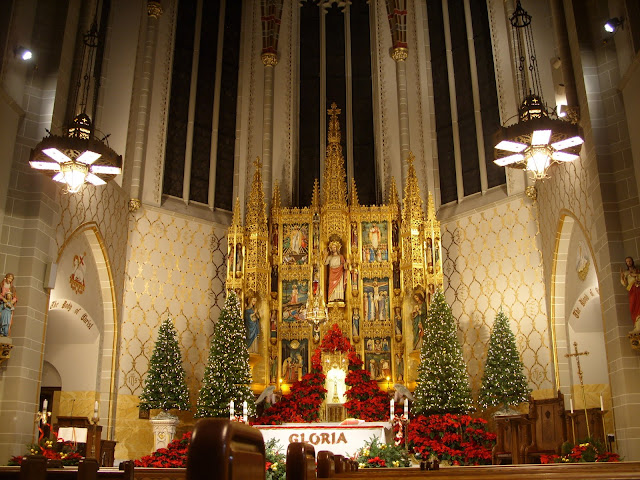
Here is the sanctuary at St. Florian. I visited on January 18th, so of course it was still decorated for Christmas.
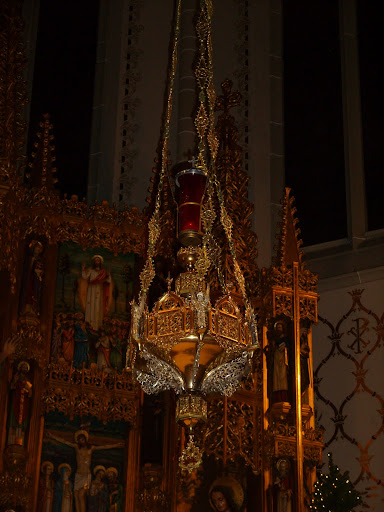
This shot of the Sanctuary lamp gives also a glimpse of the detail on the Reredos. I think these reliefs are carved wood.
St. Florian and St. Maximilian Kolbe are on the back wall:


Facade on a snowy night:

St. Florian has produced a book for their 100th anniversary. It looks rather handsome and full of great pictures, but it is pricey at $50. If you are interested in this parish and its history, this may be a nice addition to your library.
While you are in Hamtramck, how could you NOT want to have some Polish food? I naturally headed over to the Polish Village Cafe which is on Yemans street. Once a cellar beer garden in a gentlemen's hotel, it has been the restaurant since 1976. The gołabki are great, but I didn't have any on the night I stopped in. I opted for the fresh sausage in beer sauce. When the waiter asked if I would like horseradish, I nearly burst with excitement. Love me some horseradish. The main course was great, but it really shared billing with the cup of dill pickle soup. You simply must try it.

Quick Links:
In 1907/8 the first church was established in the then Village of Hamtramck. This church is St. Florian. By the mid 1920s, St. Florian had become the 2nd largest church in Detroit (Hamtramck's population increased by 1266% between the censuses of 1910 and 1920) and was in need of a new building for worship. Ralph Adams Cram was chosen for the upgrade. In terms of Ecclesiastical Architecture, Cram is kind of a big deal. The lion's share of his work was for Episcopal/Anglican churches (he was a High Church Anglican) which includes the Cathedral Church of St. Paul in Detroit. The designs of Cram and the sacrifice of the parishioners paid off and American Architect magazine chose St. Florian's as the Best new church of 1929 according to this here historical marker:
It was the best new Church in 1929, and it remains one of the best in my opinion. I have more pictures, but this is one that should be on your list for seeing in person. They have evening masses during the week, so it could be easily fit into a working person's schedule.
Here is the sanctuary at St. Florian. I visited on January 18th, so of course it was still decorated for Christmas.
This shot of the Sanctuary lamp gives also a glimpse of the detail on the Reredos. I think these reliefs are carved wood.
St. Florian and St. Maximilian Kolbe are on the back wall:
Facade on a snowy night:
St. Florian has produced a book for their 100th anniversary. It looks rather handsome and full of great pictures, but it is pricey at $50. If you are interested in this parish and its history, this may be a nice addition to your library.
While you are in Hamtramck, how could you NOT want to have some Polish food? I naturally headed over to the Polish Village Cafe which is on Yemans street. Once a cellar beer garden in a gentlemen's hotel, it has been the restaurant since 1976. The gołabki are great, but I didn't have any on the night I stopped in. I opted for the fresh sausage in beer sauce. When the waiter asked if I would like horseradish, I nearly burst with excitement. Love me some horseradish. The main course was great, but it really shared billing with the cup of dill pickle soup. You simply must try it.
Quick Links:
- St. Florian Website
- Polish Village Cafe Website
- More Images from St. Florian (Start here and click the right arrow to view the next Keep clicking until they are no longer St. Florian images, or keep going...)
Thursday, January 27, 2011
Photo Album
The Detroit Church Blog Picasa Album has gone live!
I have it more or less organized by church, and it includes additional pictures not seen in the blog posts themselves.
There is also a slide show in the sidebar.
Check it out!
I have it more or less organized by church, and it includes additional pictures not seen in the blog posts themselves.
There is also a slide show in the sidebar.
Check it out!
Subscribe to:
Posts (Atom)