Showing posts with label northeast Detroit. Show all posts

Friday, April 17, 2015

Return to Assumption Grotto


German immigrants first arrived in Detroit circa 1830 in the middle of a cholera epidemic. Some settled in what is now Greektown but many moved to the northeast outskirts of the city and settled along with a handful of French-American Catholics.

They built a log chapel, the second Catholic establishment in Detroit, where the current church stands and called it Kirchen Wald (Church in the Woods) and Redemptionist missionaries ministered there. The name was later changed to Chapel of the Assumption and later St. Mary's in the Woods.

In 1847, the parish was officially established as Assumption of the Blessed Virgin Mary and they received their first full-time pastor, Fr. Amandus Van den Driessche, in 1852. By the end of that year, the parish had its first "permanent," brick church completed with a capacity of 500.

Like many parishes at the time, a nearby cemetery was added at some point. In 1876, Van den Driessche visited France and was so impressed by the recently-constructed Sanctuary of Our Lady of Lourdes that he commissioned a replica of the grotto. This was designed by Peter Dederichs, also architect of several Catholic churches. It was constructed of limestone, standing at the far end of the cemetery, finished in 1881, and was the first outdoor shrine in Michigan.

On April 30, 1882, Pope Leo XIII signed a proclamation granting partial and plenary indulgences for anyone who visited the Grotto and prayed for the propagation of the faith. The grotto became a popular place for local pilgrimage, especially on the last Sunday of May and the Solemnity of the Assumption (August 15). The interior rim of the grotto shows each pope and the duration of his papacy.

The second church burned in 1907, and the current church was built in its place. The rectory dates to 1918 and convent to early 1920s, both constructed from red brick. 


Detroit architectural firm Aloys Frank Herman designed the current church that was built 1928-1929 and dedicated on September 22, 1929. The church was designated as a Michigan State Historic Site in 1990 and listed on the National Register of Historic Places the next year.
 

A plaque at the gate commemorates all of Assumption's pastors. Amazingly, in more than 160 years, the parish has had only 9 pastors and some have served as long as 45 years. Fr. Eduard Perrone has been pastor since 1994 and is assisted by Fr. John Bustamante as well as (permanent) Deacon James Wilder.

A large statue of Our Lady of Lourdes stands near the gate; small, narrow windows are found in the side aisles. Large windows depicting saints and symbols are in the clerestory.
 

Buttresses line the exterior walls on both sides.

Clerestory windows show various saints and Church symbols.

Windows in the northeast and southwest transepts.

The Blessed Virgin is depicted in the choir loft windows, surrounded by angels.

Communion rails are crafted from Italian marble. Angels holding a ciborium and chalice are shown on the gates.

Carved wooden details above confessionals.

Mass is offered everyday, at least twice a day. Most Masses are ad orientem with the priest facing the tabernacle during Liturgy of the Eucharist. Mass is at 7:30am and 7:00pm, Monday-Friday. 


Saturday Mass is at 7:30am and 4:00pm (Sunday Vigil). Sunday Mass is at 6:30am, 9:30am (Tridentine), and Noon. Confessions are heard half an hour before each Sunday Mass. The congregation traditionally recites the rosary after every Mass.


For more info: parish websiteTe Deum blogprevious blog postAODDetroit1701RCNet
For more photos: Flickr,  Te DeumAOD Film Services,

Tuesday, September 02, 2014

Final Mass at St. Louis the King


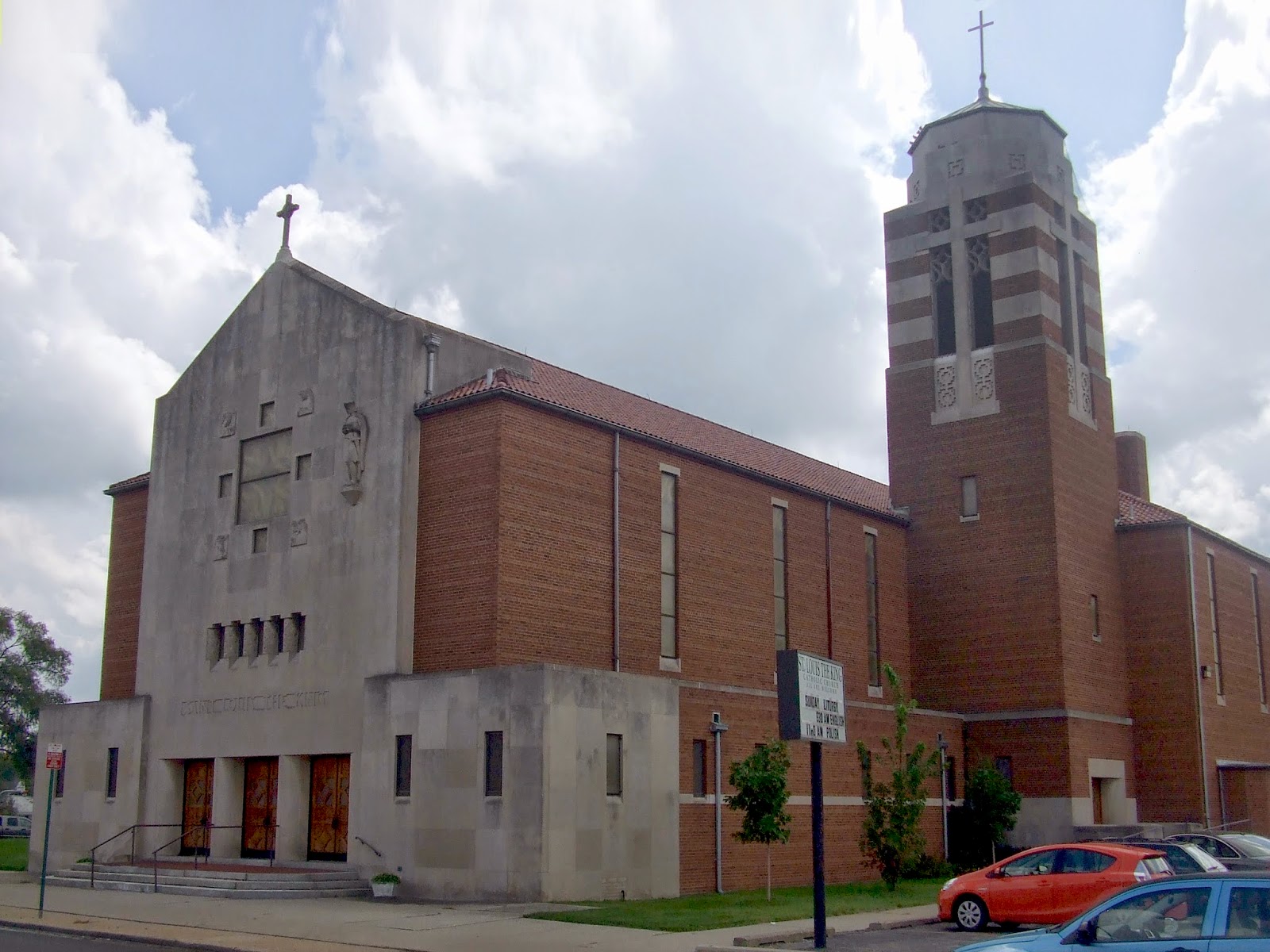
St. Louis the King Parish was established in 1923 and, like many churches in the northeast area, it had a mostly Polish congregation.

The latest edifice was designed by Walter J. Rozycki, built in 1959, and located on 7 Mile just east of Mound. Felician Sisters taught at the parish school before it closed in 1988, later demolished in 1993.


The church's namesake portrayed on the front facade as well as a side altar.

In 2012, St. Louis the King merged with St. Ladislaus and Transfiguration/Our Lady Help of Christians. St. Ladislaus will also soon close at a date TBD but Transfiguration will remain open. The last Mass at St. Louis the King was celebrated on August 31, 2013.


Agnus Dei above the high altar
.


St. Francis of Assisi, Our Lady of Fatima, St. John Paul II, and St. Joseph with child Jesus in the east transept.

The west transept housed a statue of St. Maximilian Kolbe along with a processional canopy and banners.

Side altars to Our Lady of Częstochowa and Mother of Perpetual Help.

Colorful, symbolic windows were found in the lower level of the nave as well as the sanctuary. Geometric, pale windows were found in the clerestory.
 

A cross-shaped set of windows found over the choir loft.

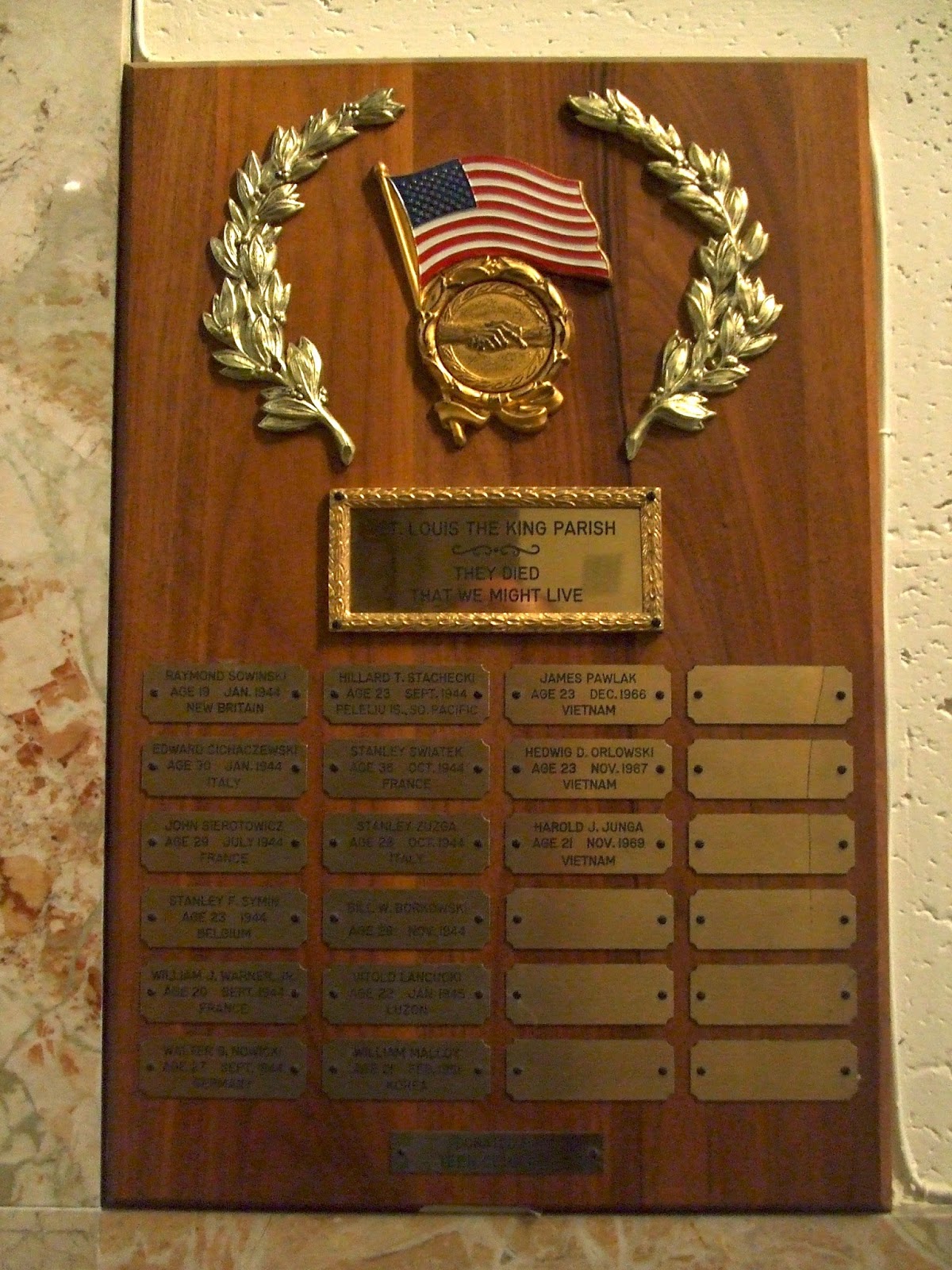
Plaques honored deceased ushers and veterans.


For more info: previous blog post, WXYZCreative Genebulletin achive

Wednesday, July 30, 2014

St. Ladislaus and St. Louis the King closing

Both St. Ladislaus (Hamtramck) and St. Louis the King (northeast Detroit) are to close in the coming months though no specific date has been set. Both churches are part of St. John Paul II Parish and their third church, Transfiguration/Our Lady Help of Christians will remain open. Inability to pay maintenance costs is cited as the reason for closure.

For more info: parish bulletin & WDIV
video platformvideo managementvideo solutionsvideo player

Thursday, May 29, 2014

Our Lady Queen of Heaven


Our Lady Queen of Heaven is located near Van Dyke and East Outer Drive in northeast Detroit. The parish was established in 1929 and supposedly the current church was finished in 1930 but, while I could not find a cornerstone, it appears to have been built mid-century.

Not surprisingly, images of the Blessed Mother are found throughout. At left is a statue above the main doorway. At right is a statue in the east yard.

A large crucifix appears in the vestibule near Madonna & Child.

Chevrons are found throughout the church: on the high altar, in the stained-glass windows, and in many of the architectural details.


Windows in the west (top) and east (bottom) transepts.


The tabernacle is located at a side altar; an engraving on the front of the lectern. 

Mass is celebrated Saturdays at 4:00pm and Sundays at 10:00am. Daily Mass is at 8:30am on Monday, Tuesday, and Thursday or as announced. Check bulletin to confirm daily Mass.


Fr. Thomas Puzio currently serves as associate pastor. Fr. Ronald Borg, CSB, currently serves as pastor though he is scheduled to retire at the end of June. Rumors have circulated that the parish may merge with St. Raymond–Our Lady of Good Counsel but no official announcement has been released.


The parish's annual festival is this Sunday.